:+86 15106109009
:sales@couplingzy.com


 English
  русский
  Español
  عربى
عربى  Português
  Deutsch
  Türk
Türk  Indonesia

LCA Tire Coupling: High-Elasticity Torque Transmission for Demanding Industrial Machinery
Content
- 1 1. Product Overview
- 2 2. Operating Principle and Structural Design
- 3 3. Major Performance Advantages
- 3.1 3.1 Extremely High Elasticity
- 3.2 3.2 Shock Absorption and Vibration Damping
- 3.3 3.3 Low Torsional Stiffness Without Torsional Clearance
- 3.4 3.4 Large Displacement Compensation Capacity
- 3.5 3.5 Dynamic Balance in Both Directions of Rotation
- 3.6 3.6 Lubrication-Free Operation
- 3.7 3.7 Rapid Tire Replacement
- 4 4. Comparison with Other Coupling Technologies
- 5 5. Technical Parameters and Product Range
- 6 6. Materials, Manufacturing, and Quality Control
- 7 7. Engineering Selection Guidelines
- 8 8. Installation and Maintenance Recommendations
- 9 9. Applications in Heavy Industry
- 10 10. Customization and Non-Standard Engineering
- 11 11. Manufacturing Strengths and Customer Support
- 12 12. Cost and Lifecycle Benefits
- 13 13. Safety Considerations
- 14 14. Recommended Procurement Information
- 15 15. Frequently Asked Questions
- 15.1 Q1. What type of coupling is the LCA product?
- 15.2 Q2. What is the main advantage of the tire design?
- 15.3 Q3. Does the LCA coupling require lubrication?
- 15.4 Q4. Can the tire be replaced without moving the shafts?
- 15.5 Q5. What displacement can the coupling compensate for?
- 15.6 Q6. Is the LCA suitable for reverse rotation?
- 15.7 Q7. What nominal torque range is available?
- 15.8 Q8. Can the coupling be customized?
- 15.9 Q9. Is the LCA appropriate for high-speed equipment?
- 15.10 Q10. What industries commonly use this coupling?
- 15.11 Q11. What should be inspected during maintenance?
- 15.12 Q12. How does the LCA compare with a gear coupling?
- 15.13 Q13. Does high flexibility eliminate shaft alignment requirements?
- 15.14 Q14. What technical documents can be requested?
- 16 16. Conclusion
- 17 References
- 18 Product: LCA type tire coupling(Q/YC 34009X-2018)
Modern industrial machinery increasingly requires coupling technology that can accommodate installation errors, absorb shock, reduce vibration, and operate reliably in difficult environments. In metallurgical plants, mines, lifting systems, paper mills, ports, water equipment, and heavy-duty transmission lines, a coupling is not merely a connection between two shafts. It is a critical mechanical component that influences equipment availability, operating noise, bearing loads, maintenance intervals, and the service life of connected machines.
The LCA type tire coupling, manufactured according to Q/YC 34009X-2018, is designed to address these requirements through a high-elasticity, non-metallic flexible element. Its frameless radial-cut tire body transmits torque through pressure plate clamping and bolt fastening. Unlike couplings that depend on rigid metal grids, gear teeth, or a steel-supported elastic assembly, the LCA design uses the deformation capacity of its tire element to provide exceptional flexibility and vibration isolation.
This construction gives the LCA tire coupling several important advantages. It offers strong shock absorption, effective noise reduction, low torsional stiffness, wide displacement compensation, lubrication-free operation, and convenient tire-unit replacement. It is particularly suitable for drive systems exposed to frequent starts and stops, reversing loads, impact torque, installation deviations, foundation movement, or environmental contamination.
Zhongye Heavy Industry Technology (Zhenjiang) Co., Ltd. combines product development, manufacturing, testing, and technical service to provide this coupling in a broad range of sizes. The company also supports customized and non-standard coupling solutions for applications where standard dimensions, shaft arrangements, materials, or operating conditions require modification.
1. Product Overview
The LCA tire coupling is a flexible coupling with a non-metallic elastic element. Its main working component is a resilient tire body connected to two hubs or flanges. The tire is clamped by pressure plates and bolts, allowing torque to pass from one shaft to the other while the elastic body accommodates relative movement between the shafts.
The coupling is designed for systems in which two shafts must transmit torque while remaining protected from excessive torsional shock and moderate alignment deviations. During operation, the tire element deforms elastically. This deformation allows the coupling to absorb energy generated by motor starting, load changes, emergency stopping, reversing, and uneven resistance from the driven machine.
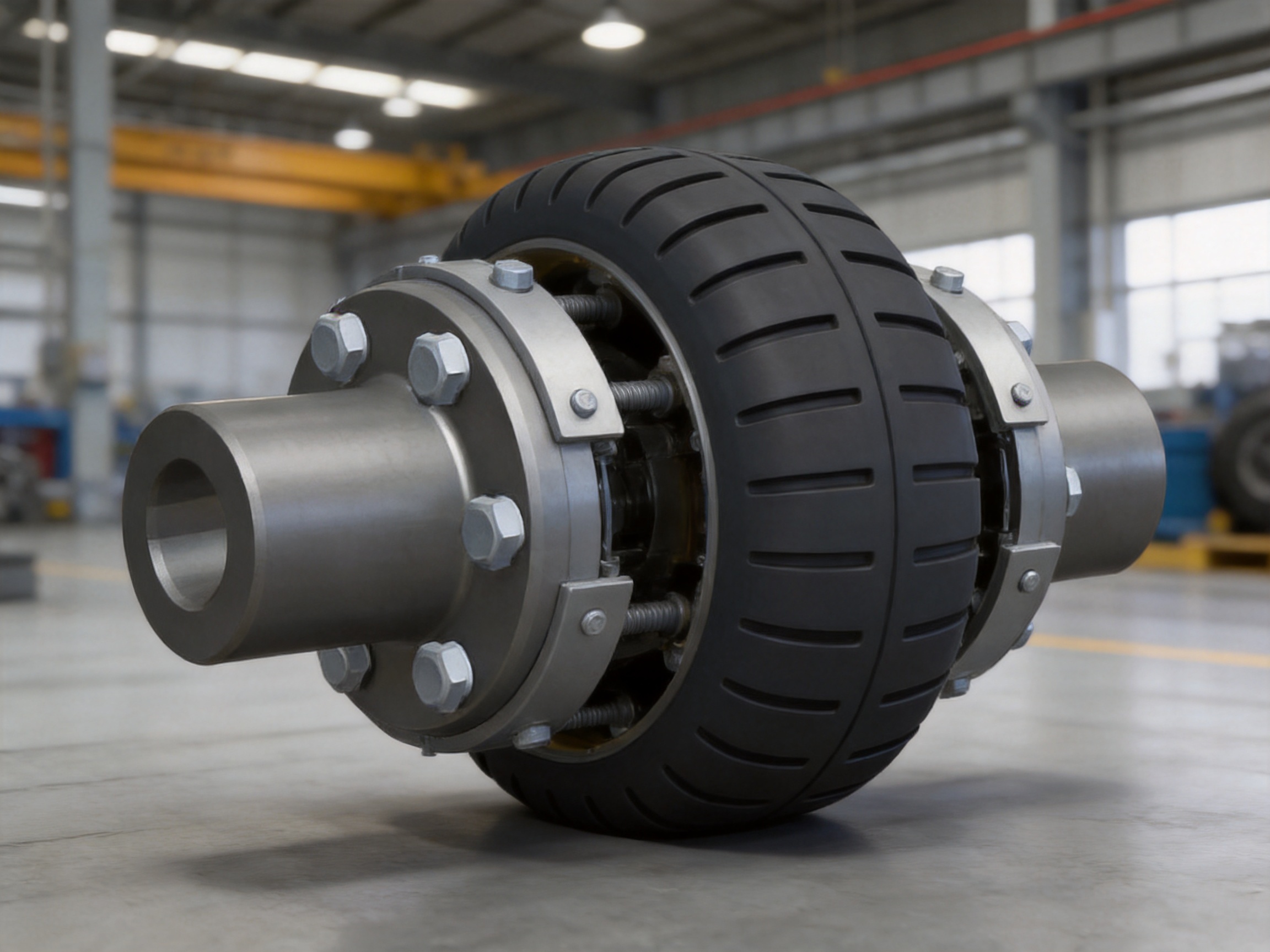
A principal feature of the LCA structure is its frameless radial-cut tire body. The absence of an internal steel frame reduces torsional stiffness and increases the available elastic deformation. This helps the coupling absorb high-frequency disturbances instead of transmitting them directly into the motor, gearbox, bearings, rolls, pumps, conveyors, or other connected equipment.
The product range covers nominal torques from 10 N·m to 20,000 N·m. Depending on the selected size and shaft configuration, allowable speeds range from approximately 800 r/min to 5,000 r/min. Shaft hole options extend from small diameters suitable for compact machinery to large bore sizes for heavy industrial drives.
Because different installations require different shaft connections, the LCA coupling can be supplied with various bore arrangements and shaft-hole lengths. The standard product information includes options associated with Y, J, J1, and Z shaft-hole forms, together with corresponding dimensions for the hubs and tire assembly.
2. Operating Principle and Structural Design
The operating principle of the LCA tire coupling is based on elastic frictional and mechanical torque transmission through a clamped tire element. The driving hub rotates with the input shaft. Pressure plates and fastening bolts secure the tire to the hub assemblies. When the driving shaft turns, the clamped tire transfers torque to the driven hub and shaft.
At the same time, the tire body remains capable of radial, axial, and angular deformation. If the two connected shafts are not perfectly aligned, the tire flexes rather than forcing the shafts to follow a rigid geometric relationship. This characteristic reduces the transmission of alignment-related forces to the connected machinery.
The frameless design is important because a steel frame inside an elastic element can increase rigidity and restrict deformation. The LCA configuration allows the tire body to function as a comparatively soft torsional spring. It can therefore absorb sudden torque changes and damp oscillation more effectively than many conventional couplings with higher torsional stiffness.
During a motor start, for example, the drive system may experience a rapid rise in torque. The flexible tire deforms and absorbs part of the transient energy. During a sudden change in load, the same element helps prevent the impact from propagating directly through the shaft line. In reversing applications, the absence of torsional backlash is especially valuable because it supports smoother bidirectional torque transmission.
The coupling does not depend on oil or grease for normal operation. This eliminates the need for routine lubrication of the flexible element and reduces the risk of lubricant leakage, contamination, or incorrect maintenance. In applications where dust, moisture, scale, or water spray is present, the lubrication-free design can simplify service procedures.
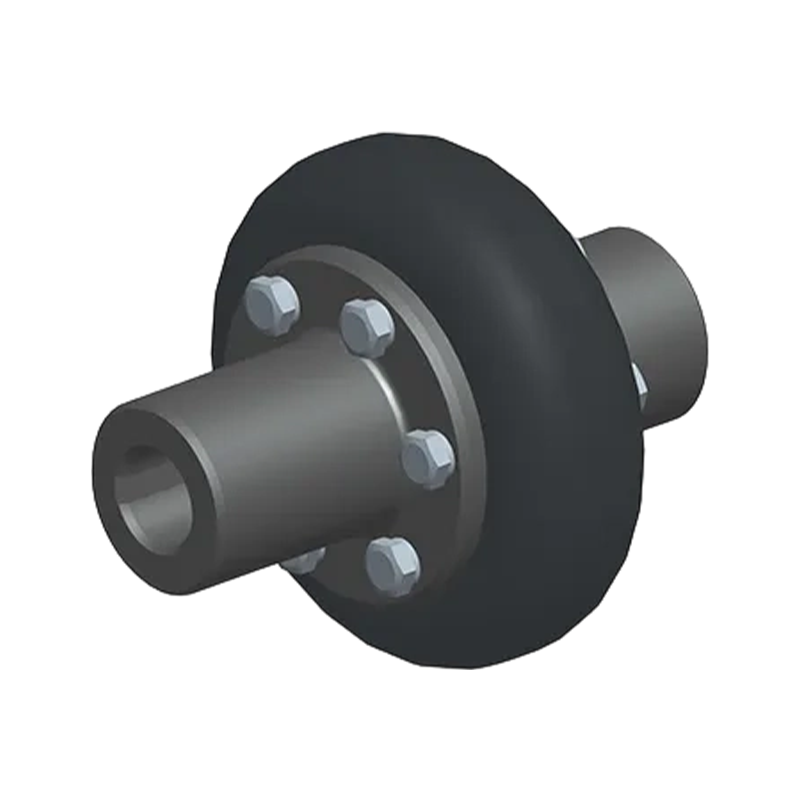
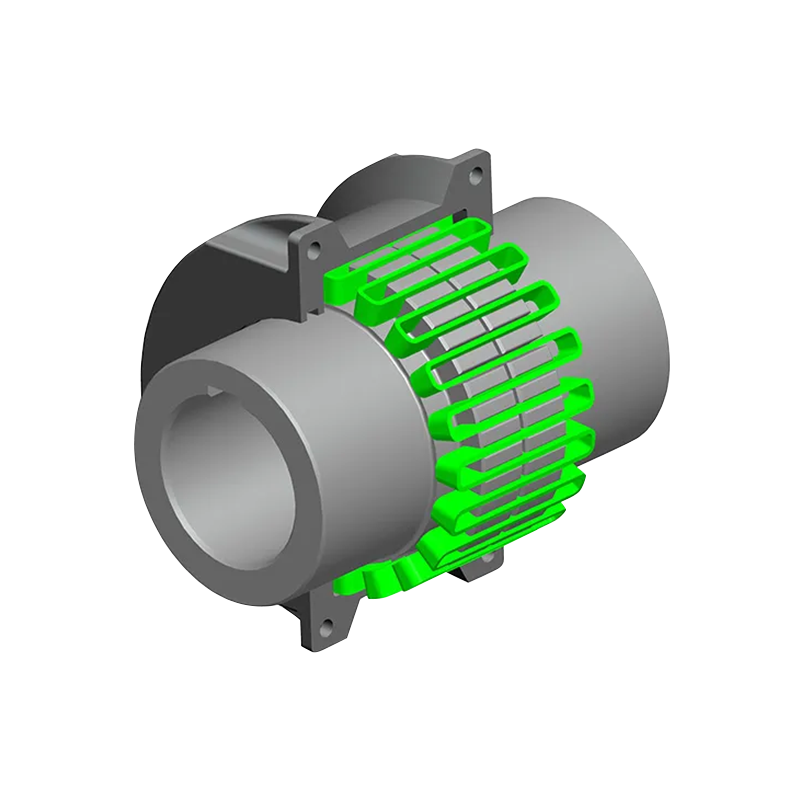
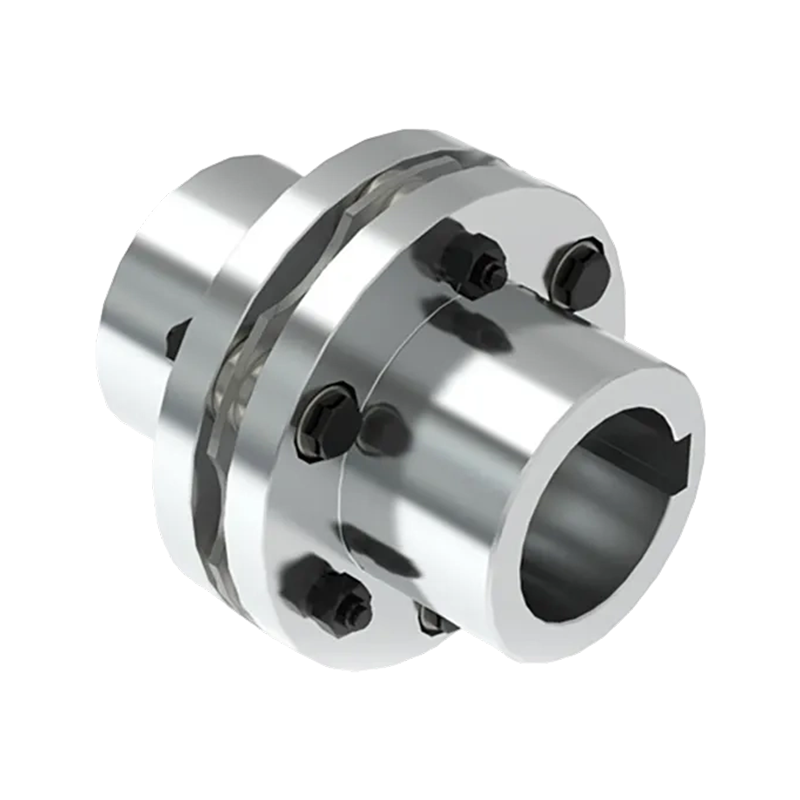
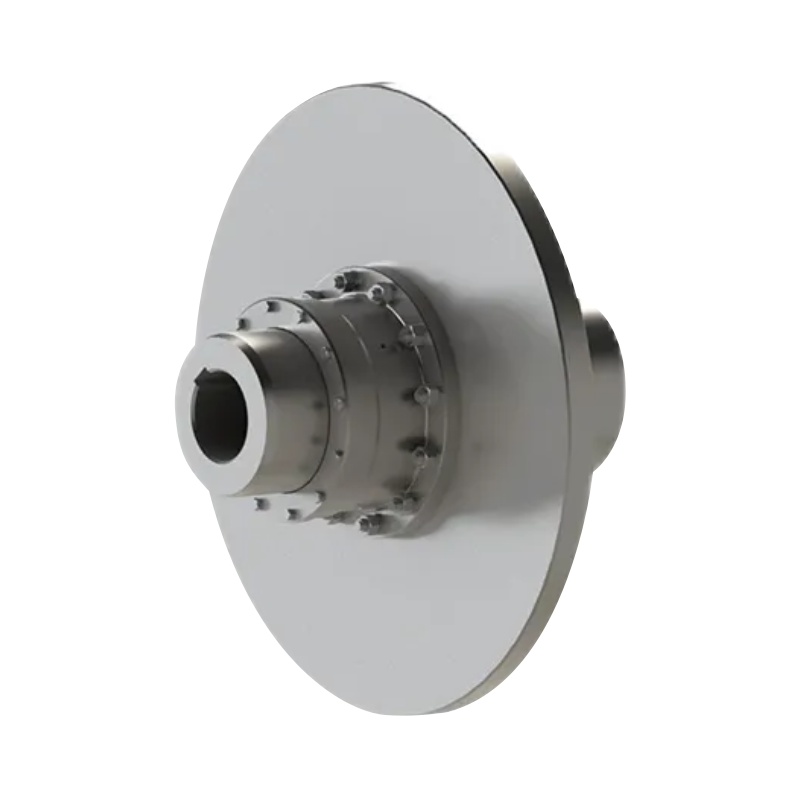
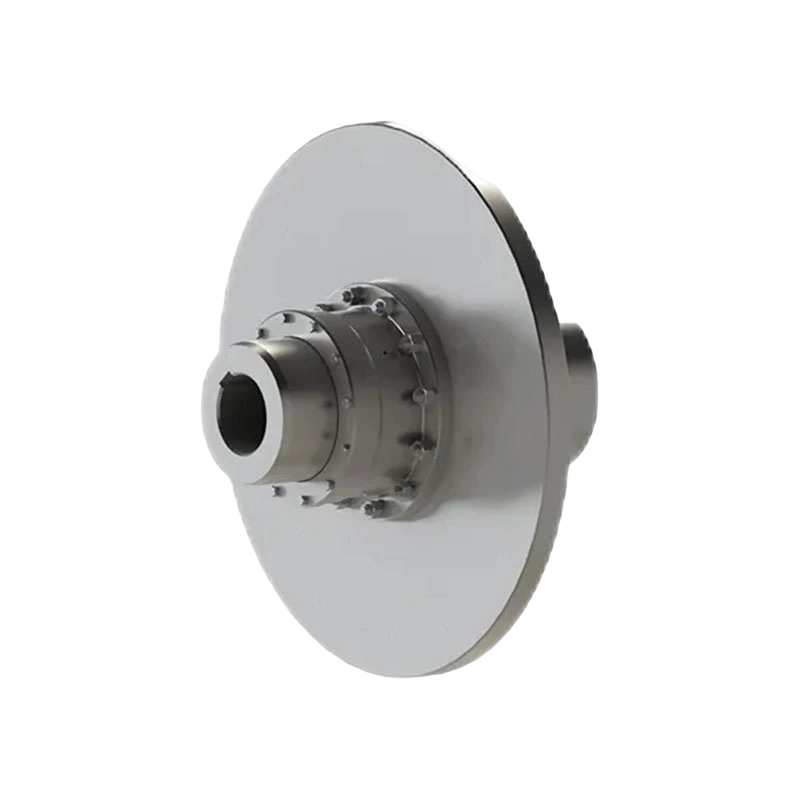
LCA type tire coupling(Q/YC 34009X-2018)
3. Major Performance Advantages
3.1 Extremely High Elasticity
The most prominent characteristic of the LCA tire coupling is its high elasticity. A flexible element with high elastic deformation capacity can accommodate movement while continuing to transmit torque. This is important for machinery installed on large foundations, equipment exposed to thermal expansion, and systems in which the shaft centerline changes slightly under load.
High elasticity also gives the coupling a comparatively low torsional stiffness. Rather than acting as a rigid extension of the shaft, the coupling becomes an elastic buffer between the driver and the driven machine. This buffer can reduce the severity of torque peaks and limit the transfer of sudden mechanical disturbances.
3.2 Shock Absorption and Vibration Damping
Industrial drives often operate under non-uniform loads. Crushers, conveyors, rolling equipment, pumps, lifting mechanisms, and paper-processing systems can generate pulsating or impact torque. If these forces are transmitted without damping, they may increase bearing wear, loosen fasteners, damage gear teeth, or create noise throughout the machine.
The LCA tire body absorbs a portion of this energy through elastic deformation. The resulting damping effect helps moderate torsional vibration and reduce mechanical shock. Its performance is particularly beneficial in systems with frequent starting and stopping, repeated acceleration, reversing, or intermittent loads.
Vibration reduction can also improve the working environment. A lower vibration level may reduce structure-borne noise, minimize resonance risks, and support more stable operation of nearby instruments and equipment. The actual level of damping depends on the selected tire material, load, speed, temperature, alignment, and operating conditions, so engineering selection remains essential.
3.3 Low Torsional Stiffness Without Torsional Clearance
Low torsional stiffness and low backlash are often difficult to achieve together. Some rigid or gear-based arrangements can transmit torque precisely but may pass impact loads directly into the shaft system. Other mechanisms may introduce clearance that becomes noticeable during reversing or positioning.
The LCA tire coupling uses elastic deformation rather than intentional mechanical clearance to accommodate torsional movement. As a result, forward and reverse rotation can remain dynamically balanced without the torsional clearance associated with certain backlash-based coupling arrangements.
This feature is useful in reversing drives and systems that alternate torque direction. It can help reduce impact at the moment of reversal and support more predictable torque transfer between the motor and the machine.
3.4 Large Displacement Compensation Capacity
According to the supplied product information, the LCA coupling can compensate for axial deviations of up to ±10 mm and angular offsets of approximately 3 degrees, subject to the actual application conditions and the manufacturer’s technical confirmation.
This capacity is considerably greater than the compensation range commonly expected from more rigid coupling designs. It can help accommodate shaft movement caused by thermal expansion, foundation settlement, installation tolerance, frame deformation, and load-induced displacement.
Large compensation capacity does not remove the need for proper alignment. Correct installation remains necessary to control reaction forces, prevent excessive tire deformation, and achieve the expected service life. However, the LCA design provides a broader tolerance window and is more forgiving when real operating conditions differ from ideal design geometry.
3.5 Dynamic Balance in Both Directions of Rotation
Many industrial machines operate in both forward and reverse directions. Reversing may be required for positioning, unjamming, process control, lifting, material handling, or emergency recovery. The LCA tire coupling is designed to maintain dynamic balance during forward and reverse rotation without relying on torsional clearance.
Balanced operation helps reduce vibration and supports smooth torque transmission. For high-speed installations, the selected coupling size, bore arrangement, rotational speed, and installation accuracy must be checked together. The allowable speed shown in the product data is a reference for selection and should not be treated independently of the actual operating environment.
3.6 Lubrication-Free Operation
Unlike gear couplings and some grid couplings, the LCA tire coupling does not require routine lubrication of its flexible tire element. This is a practical advantage in dusty, humid, wet, or difficult-to-access locations.
Lubrication-free operation can reduce scheduled maintenance labor and eliminate the need to store, apply, and dispose of coupling grease. It also avoids problems caused by insufficient lubrication, over-lubrication, contamination, or lubricant leakage into nearby production areas.
Although no lubrication is required, inspection is still important. Operators should periodically check the tire for cracking, abnormal wear, deformation, heat damage, chemical attack, and bolt-related problems. Lubrication-free does not mean maintenance-free; it means that maintenance focuses on condition inspection and mechanical integrity rather than grease replenishment.
3.7 Rapid Tire Replacement
A major service advantage of the LCA design is that the tire unit can be replaced without moving the connected shaft system, provided that the installation arrangement and available working clearance meet the manufacturer’s requirements.
This feature is especially valuable for large machines. Moving a motor, gearbox, pump, roll, or conveyor drive can require lifting equipment, extended alignment work, and a long production shutdown. If the worn tire can be replaced in position, maintenance teams can reduce downtime and restore the drive more quickly.
Faster replacement also reduces the risk of disturbing the alignment of the connected machinery. After a conventional coupling replacement, the entire shaft line may require renewed alignment. The LCA replacement method can simplify this process when the surrounding structure is appropriately designed.
4. Comparison with Other Coupling Technologies
4.1 Compared with Rigid Couplings
Rigid couplings are suitable when the connected shafts are precisely aligned and must behave as one continuous shaft. Their simple construction can provide high torsional rigidity, but they have very limited ability to accommodate axial, angular, or parallel displacement.
The LCA tire coupling is better suited to installations where alignment may change during operation. Its elastic element reduces the transfer of displacement forces and absorbs transient torque. Therefore, it can protect connected equipment more effectively when the machine experiences foundation movement, thermal expansion, or load deformation.
A rigid coupling may still be preferable for a precisely aligned shaft system where no flexibility is required. The correct choice depends on the mechanical design, not on the nominal torque alone.
4.2 Compared with Gear Couplings
Gear couplings can transmit high torque in a compact package and are widely used in heavy machinery. However, their gear teeth and sliding engagement typically require lubrication and periodic inspection. They may also generate backlash, tooth wear, and noise if lubrication or alignment conditions are unfavorable.
The LCA tire coupling offers lubrication-free operation, lower maintenance complexity, and strong shock absorption. Its tire element can accommodate larger displacement in many applications, while its low torsional stiffness helps isolate vibration.
Gear couplings may be selected when very high torque density, compact axial dimensions, or high torsional rigidity is the priority. The LCA design is advantageous when flexibility, damping, reduced maintenance, and displacement compensation are more important.
4.3 Compared with Grid Couplings
Grid couplings use a metallic grid element to transmit torque and absorb some shock. They can provide useful damping but generally depend on lubrication and may require more complex inspection of the grid and covers.
The non-metallic tire element of the LCA coupling offers a different balance of performance. Its high elasticity and low torsional stiffness can be particularly effective in high-frequency start-stop conditions. The absence of a metallic grid simplifies the flexible element and supports quick tire replacement.
Grid couplings may offer higher torsional stiffness in certain designs, while the LCA tire coupling is intended for applications where elastic compliance and vibration isolation are key requirements.
4.4 Compared with Diaphragm Couplings
Diaphragm couplings can provide high-speed operation, precise torque transmission, and strong axial or angular flexibility. They are often used in carefully controlled, high-speed equipment. However, diaphragm elements are sensitive to excessive misalignment, installation error, and overload conditions.
The LCA tire coupling has a more forgiving elastic body and is suitable for industrial machinery exposed to shock, dust, moisture, and changing alignment. Its structure is especially practical for heavy-duty equipment where ease of maintenance and impact resistance are more important than extremely high torsional rigidity or minimal package size.
4.5 Compared with Elastomeric Jaw or Spider Couplings
Jaw couplings and star couplings are compact and effective for small and medium drives. Their elastomeric spiders can absorb moderate shock and compensate for limited misalignment. However, their capacity and compensation range are generally more restricted than those required by large heavy machinery.
The LCA range extends to nominal torques of 20,000 N·m and includes large shaft bores. Its tire structure is therefore appropriate for significantly larger drive systems. For compact motors and instrumentation, a jaw or star coupling may be more economical. For large, impact-loaded machinery, the LCA offers greater elastic capacity and service flexibility.
5. Technical Parameters and Product Range
The LCA product family includes multiple sizes for different torque, speed, bore, and dimensional requirements. The following table summarizes the principal data supplied for the standard range. Some individual shaft-hole and length values are arranged according to the associated hub configuration and should be confirmed against the manufacturer’s detailed drawing before ordering.
| Type | Nominal Torque (N·m) | Allowable Speed (r/min) | Representative Shaft Bore Range (mm) | Approx. Outside Diameter D (mm) | Approx. Mass (kg) |
|---|---|---|---|---|---|
| LCA1 | 10 | 5,000 | 6–11 | 63 | 0.35 |
| LCA2 | 20 | Not specified in supplied data | 8–19 | 100 | 1.33 |
| LCA3 | 80 | 4,000 | 18–28 | 135 | 3.4 |
| LCA4 | 160 | 3,150 | 25–38 | 180 | 7.4 |
| LCA5 | 315 | 2,800 | 30–50 | 210 | 13.5 |
| LCA6 | 630 | 2,500 | 40–56 | 265 | 22.6 |
| LCA7 | 1,250 | 2,000 | 45–75 | 310 | 84.8 |
| LCA8 | 2,500 | 1,600 | 60–95 | 400 | 74.3 |
| LCA9 | 5,000 | 1,250 | 80–125 | 450 | 111.5 |
| LCA10 | 10,000 | To be confirmed | 100–150 | 560 | 191.3 |
| LCA11 | 20,000 | 800 | 130–180 | 700 | 373 |
The supplied information also lists moment of inertia values from approximately 0.0004 kg·m² for the smallest model to approximately 54.1 kg·m² for the largest model. These values are important in applications involving rapid acceleration, deceleration, reversing, or servo-like dynamic behavior.
Torque selection should consider more than the steady operating torque. Engineers should evaluate motor starting torque, overload conditions, acceleration time, braking torque, reversing frequency, service factor, ambient temperature, chemical exposure, shaft alignment, and the expected number of operating cycles.
For example, a conveyor that normally operates at moderate torque may experience high transient loads when starting with a full material load. A crusher or rolling machine may create repeated impact torque. A lifting device may apply changing loads during acceleration and braking. The selected coupling must be capable of handling these conditions without excessive tire deformation or premature fatigue.
6. Materials, Manufacturing, and Quality Control
The reliability of a tire coupling depends on the quality of both its metallic components and its non-metallic elastic element. The hubs and pressure plates must have accurate dimensions, sufficient strength, and stable bolt seating. The tire must have consistent material properties, uniform geometry, and resistance to fatigue, heat, aging, and environmental exposure.
Zhongye Heavy Industry Technology integrates research and development, manufacturing, and sales. This integrated structure allows technical requirements to be reviewed during product design, material preparation, machining, assembly, testing, and final delivery.
The company’s new workshop covers approximately 16,463.52 square meters. It includes a heavy workshop of approximately 5,500 square meters, a precision workshop of approximately 4,600 square meters, an office building and gymnasium, a dining facility, a warehouse, and supporting roads, green areas, and parking space.
The heavy workshop supports the production of large coupling components and heavy-duty assemblies. This capability is important for large tire couplings, universal couplings, drum couplings, gear couplings, and other products used in metallurgical and mining equipment. Adequate workshop space also supports safer material handling, organized assembly, and the processing of large workpieces.
The precision workshop is suitable for dimensional machining, bore preparation, keyway processing, surface finishing, and inspection of components requiring closer tolerances. Accurate hub geometry is essential because misalignment, eccentricity, or uneven clamping can affect coupling balance and tire loading.
Quality control should cover incoming materials, machining dimensions, bore and keyway accuracy, bolt-hole positioning, surface condition, assembly fit, tire appearance, hardness or elasticity characteristics where applicable, and final product verification. For rotating components, balancing and runout checks are also important, especially at higher operating speeds.
The company states that it maintains strict quality control and provides products that comply with international standards and certifications such as ISO 9001. Customers requiring project-specific documentation can request inspection records, material certificates, dimensional drawings, balancing information, and other technical documents according to the order requirements.
7. Engineering Selection Guidelines
7.1 Determine the Operating Torque
The first selection step is to calculate the torque transmitted by the shaft. For motor-driven equipment, torque can be estimated from power and speed using the appropriate engineering relationship. The calculated operating torque should then be multiplied by a service factor that reflects the application’s impact, starting, braking, reversing, and duty conditions.
The nominal torque of the selected LCA model should exceed the design torque. A coupling should not be selected solely because its nominal torque is equal to the normal running torque. Insufficient allowance for transient loading can lead to overheating, excessive deformation, accelerated fatigue, or tire failure.
7.2 Check Speed and Dynamic Requirements
The operating speed must remain within the allowable speed of the selected model. High-speed applications require particular attention to balance, bore accuracy, hub concentricity, installation runout, and shaft alignment.
Where the machine has a high moment of inertia or frequent acceleration and deceleration, the coupling’s own inertia should be included in the dynamic calculation. The LCA product data provide moment of inertia values for reference. The engineering team should also assess torsional natural frequency and resonance risk when the drive has a variable-speed motor or a long shaft line.
7.3 Confirm Shaft and Bore Details
The shaft diameter, shaft-hole length, key dimensions, shoulder location, and available axial space must be checked before final selection. A suitable coupling must have adequate engagement length and sufficient clearance for assembly and maintenance.
Different shaft-hole forms may be available for the same coupling size. The customer should provide complete shaft drawings or dimensional information to ensure that the selected hubs fit correctly. Special bores, taper bores, spline connections, or non-standard key arrangements can be evaluated as customized requirements.
7.4 Evaluate Misalignment
The expected axial and angular movement should be determined from the machine design. The LCA tire coupling has a high displacement compensation capability, but the permissible values depend on speed, torque, temperature, and duty cycle.
Initial alignment should always be performed as accurately as practical. A flexible coupling is designed to accommodate unavoidable movement, not to compensate for careless installation. Excessive permanent misalignment increases tire deformation and can shorten service life.
7.5 Review the Environment
Ambient conditions can affect the life of a non-metallic tire. Engineers should identify operating temperature, humidity, water exposure, dust, oil, solvents, acids, alkalis, ultraviolet exposure, and nearby heat sources.
For humid and dusty industrial environments, the LCA’s lubrication-free design is advantageous. However, the tire material must still be compatible with the specific chemicals and temperatures present. If the drive is exposed to unusual media or extreme heat, the customer should request material confirmation before production.
8. Installation and Maintenance Recommendations
Before installation, inspect the coupling components for transportation damage, corrosion, contamination, or dimensional defects. Check the shaft ends, keyways, hub bores, and mounting surfaces. Remove burrs and ensure that the shaft surfaces are clean and dry.
Install the hubs according to the approved drawing and use the specified fit, key, washer, and fastening arrangement. The pressure plate bolts must be tightened in a controlled sequence and to the specified torque. Uneven tightening can produce non-uniform tire loading and affect dynamic balance.
After assembly, verify the axial position and angular alignment of the connected shafts. Confirm that the tire is not twisted, pinched, or subjected to an installation condition outside the approved range. Check that the coupling has adequate surrounding clearance for rotation and future tire replacement.
During commissioning, observe the coupling at low speed if possible. Look for abnormal oscillation, rubbing, noise, bolt movement, or tire distortion. Gradually increase the operating speed and load while monitoring vibration and temperature.
Routine inspection should include the following items:
1. Check the tire body for cracks, cuts, swelling, hardening, softening, or surface separation.
2. Check for abnormal wear caused by excessive misalignment or contact with adjacent components.
3. Inspect pressure plates, hubs, bolts, washers, and locking features.
4. Confirm that no fastener has loosened or shifted.
5. Examine the coupling for unusual noise, vibration, heat, or odor.
6. Verify that the operating conditions have not exceeded the original design assumptions.
When tire replacement is required, isolate the machine, lock out all energy sources, and follow the approved maintenance procedure. The ability to replace the tire without moving the shaft system should be used only when the coupling installation has been designed for this procedure and sufficient access is available.
9. Applications in Heavy Industry
9.1 Metallurgical Equipment
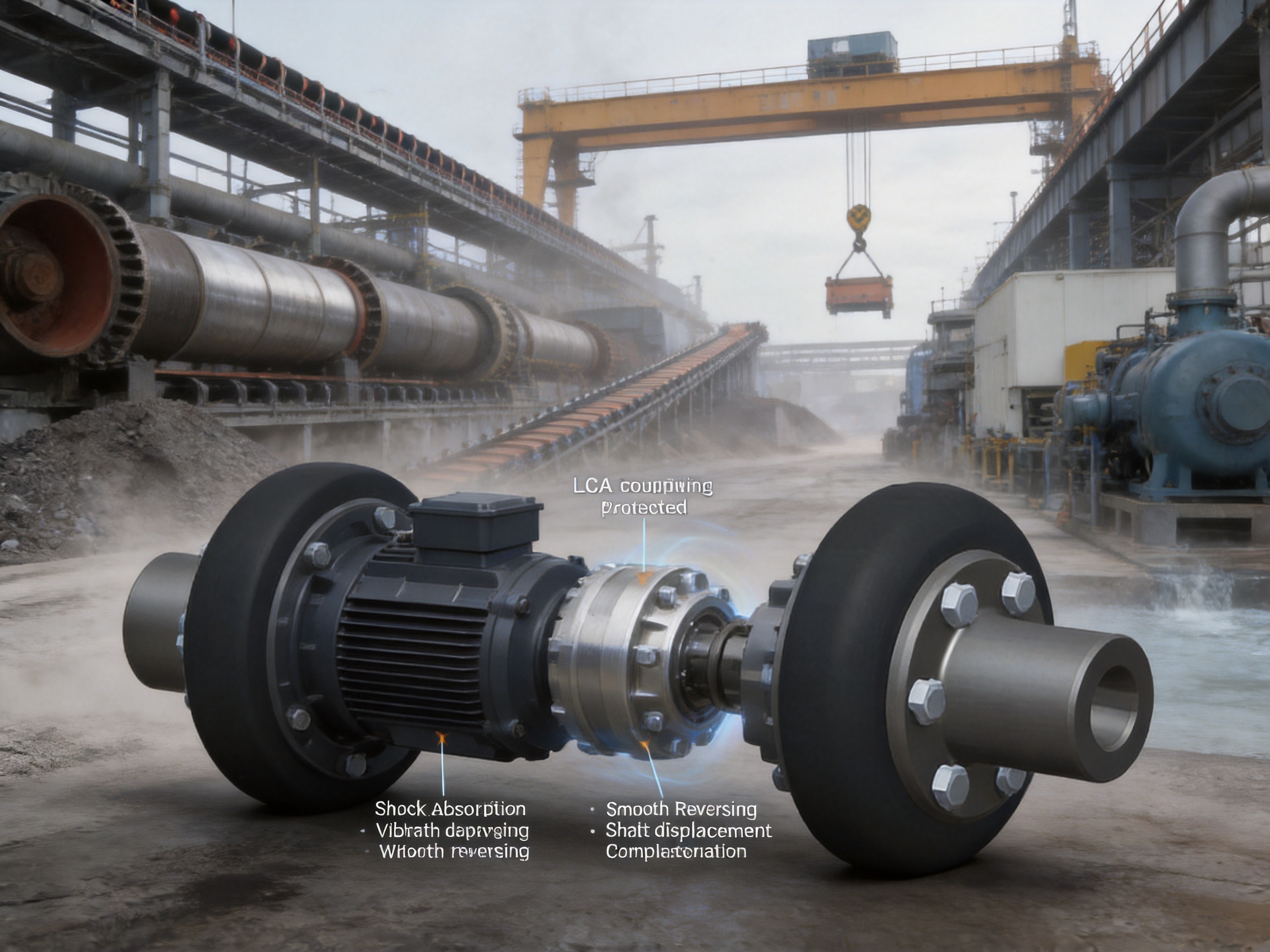
Metallurgical machinery often operates under high loads, elevated temperatures, vibration, scale, dust, and frequent process changes. Rolling equipment and auxiliary drives can transmit fluctuating torque and experience alignment changes as structures heat and cool.
The LCA tire coupling can provide a flexible connection between motors, reducers, rolls, fans, pumps, and other equipment. Its shock absorption helps moderate load changes, while its lubrication-free design reduces the need for grease service in contaminated plant areas.
9.2 Mining Machinery
Mining equipment commonly encounters impact loads, abrasive dust, moisture, large inertia, and difficult maintenance access. Conveyors, crushers, screens, pumps, hoists, and material-handling systems may be exposed to repeated starts and stops or unbalanced loads.
The LCA coupling’s low torsional stiffness and resilient tire element help absorb disturbances generated by the process. Its rapid tire replacement feature can reduce maintenance time, which is particularly valuable where equipment shutdowns affect production output.
9.3 Lifting and Port Equipment
Cranes, hoists, winches, ship loaders, stackers, and port conveyors frequently accelerate and brake large suspended or moving loads. These conditions can create transient torque and reversing forces.
A flexible coupling can reduce the severity of mechanical shock transmitted through the drive line. The LCA design is suitable for applications where smooth reversing, high displacement tolerance, and simple inspection are required. Proper braking and emergency-stop calculations remain essential during selection.
9.4 Paper and Water Equipment
Paper machinery requires stable rotation and controlled vibration, while water equipment may operate in humid or splash-prone locations. Pumps and auxiliary drives can also experience starting torque and hydraulic load variation.
The LCA coupling provides a clean, lubrication-free alternative for suitable drive arrangements. Its vibration-damping characteristics can support smoother operation and reduce the transfer of torsional fluctuation into sensitive equipment.
9.5 General Heavy Machinery
The product can be used in many other industrial systems, including fans, mixers, compressors, conveyors, rolling tables, hydraulic equipment, production lines, and customized power transmission units. Its broad torque range allows the same basic design concept to be applied from compact machinery to large industrial drives.
10. Customization and Non-Standard Engineering
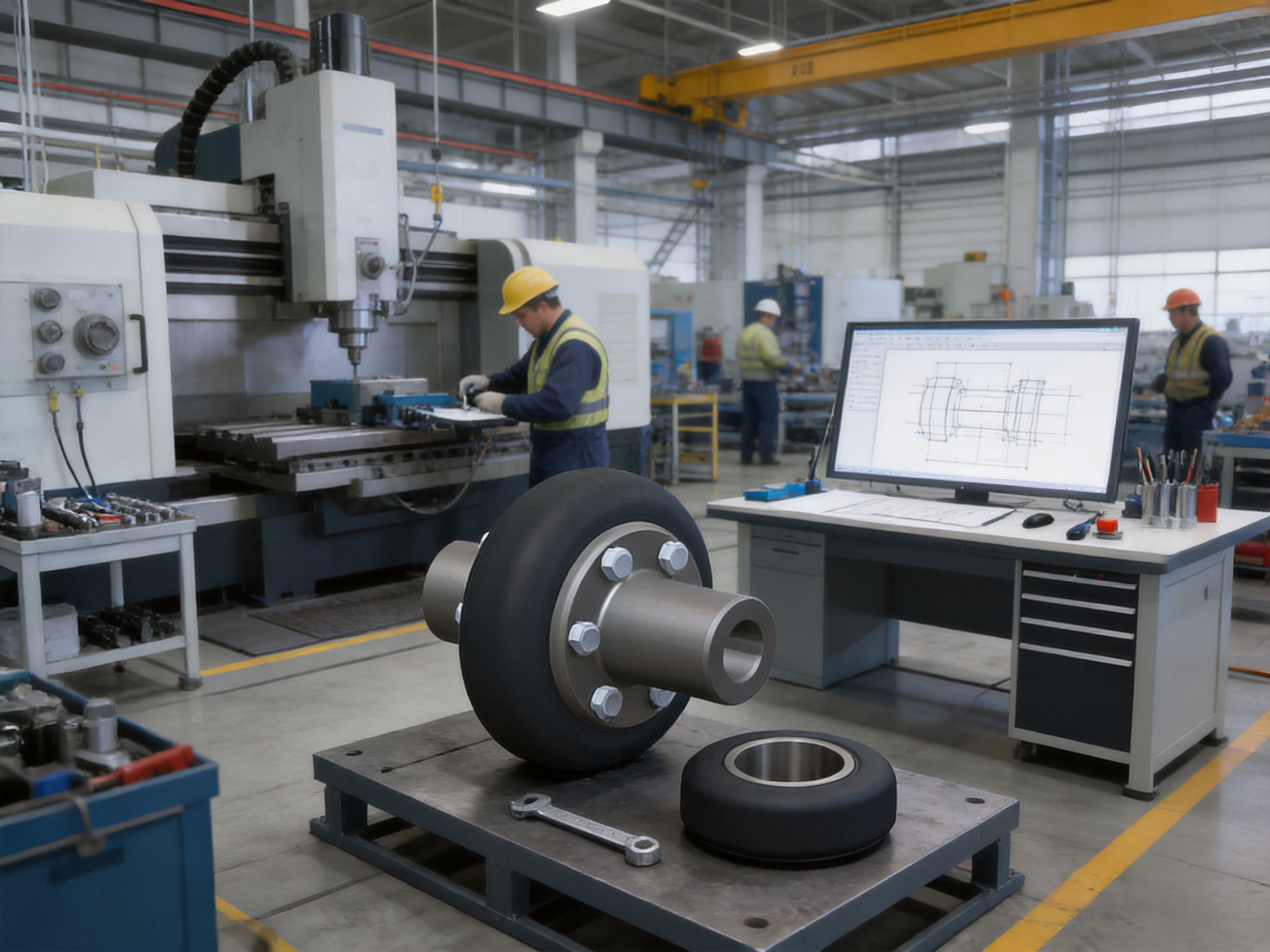
Standard coupling dimensions provide an efficient solution for many applications, but industrial equipment often includes unique shaft spacing, mounting limitations, speed requirements, or environmental conditions. Zhongye supports the design and manufacture of non-standard couplings and can evaluate customized LCA configurations.
Customization may involve special shaft bores, modified hub dimensions, non-standard shaft-hole lengths, different keyway arrangements, special materials, altered flange geometry, protective covers, or adaptation to existing equipment. Customers should provide shaft drawings, motor power, operating speed, torque characteristics, alignment data, ambient conditions, and maintenance requirements.
For a new machine, it is best to involve the coupling manufacturer during the early design stage. Early cooperation allows the shaft spacing, guard arrangement, access openings, bolt positions, and replacement clearance to be optimized around the coupling.
For replacement projects, the original coupling identification, measured shaft dimensions, photographs, installation drawings, and operating history are useful. If the original coupling failed prematurely, information about the failure mode can help identify whether the cause was overload, chemical exposure, excessive misalignment, heat, incorrect tightening, or a change in operating conditions.
The company’s product portfolio includes toothed couplings, elastic sleeve pin couplings, elastic pin couplings, gear couplings with elastic pins, universal couplings, tire couplings, jaw couplings, star couplings, diaphragm couplings, drum couplings, grid couplings, Oldham couplings, flange couplings, clamp-shell couplings, roller-chain couplings, safety couplings, and other customized products.
This broad product capability is useful because a customer may require several coupling types within one project. A manufacturer capable of evaluating the complete shaft-line system can help ensure that each coupling is selected according to the actual operating requirements rather than treated as an isolated component.
11. Manufacturing Strengths and Customer Support
A coupling manufacturer’s value is determined not only by its catalog range but also by its ability to convert technical requirements into repeatable products. Zhongye combines product development, manufacturing, testing, sales, and service within one organization.
The company serves metallurgical equipment, mining equipment, water equipment, lifting equipment, paper equipment, port equipment, and other industrial sectors. Experience across these industries helps the technical team understand practical issues such as limited maintenance access, variable loads, contamination, long operating hours, and the need for rapid replacement.
Strong research and development capability supports the evaluation of new shaft arrangements, unusual load conditions, non-standard dimensions, and application-specific coupling requirements. Manufacturing capability supports the production of both standard and large components. Testing facilities and quality procedures provide a basis for verifying product conformity before delivery.
Pre-sale technical support is important in coupling selection. A customer may know the motor power and shaft diameter but lack sufficient information about service factor, transient torque, displacement, or tire material compatibility. Technical communication can help prevent under-selection and reduce the risk of installation problems.
After-sale service is equally important. Couplings are part of operating machinery, so questions may arise during installation, commissioning, inspection, or replacement. Clear drawings, assembly instructions, maintenance recommendations, and responsive technical support can improve the total ownership experience.
The company’s stated quality system includes international standards and certifications such as ISO 9001. A quality management system helps organize document control, process control, inspection records, corrective action, and continuous improvement. For industrial customers, these systems are important when products are used in safety-critical or production-critical equipment.
12. Cost and Lifecycle Benefits
The purchase price of a coupling is only one part of its economic value. A more meaningful evaluation includes installation time, lubrication labor, spare-parts requirements, unplanned downtime, damage to connected equipment, and the frequency of alignment correction.
The LCA coupling can reduce lifecycle costs in several ways. Its lubrication-free operation eliminates routine grease service for the tire element. Its high elasticity can help reduce shock-related wear in bearings, shafts, and gearboxes. Its broad displacement compensation can reduce the consequences of small alignment changes. Its tire replacement method can shorten maintenance shutdowns.
These benefits are especially significant in mines, steel plants, ports, and other facilities where production interruptions are expensive. A coupling that costs slightly more initially may provide a lower total cost if it reduces service labor and prevents secondary damage.
Lifecycle performance still depends on proper sizing and maintenance. An incorrectly selected or improperly installed tire coupling can fail prematurely regardless of its design advantages. Therefore, application engineering, installation quality, and periodic inspection should be considered part of the product solution.
13. Safety Considerations
Rotating couplings can cause serious injury if they are operated without appropriate guarding. The LCA coupling should be installed with a suitable protective guard that prevents contact with the rotating tire, pressure plates, bolts, and hubs.
Before inspection or replacement, the drive must be stopped and isolated. Electrical, hydraulic, pneumatic, gravitational, and stored mechanical energy must be controlled. Maintenance personnel should follow the plant’s lockout and tagout procedures.
Do not operate the coupling if the tire shows major cracking, exposed reinforcement, severe deformation, unusual heat damage, or contact with the guard. Do not continue operation if bolts are missing, loose, damaged, or incorrectly installed.
Safety factors and emergency conditions should be reviewed during design. In lifting equipment, braking systems and load-holding mechanisms must not depend on the coupling alone. In high-speed systems, balance and guard integrity must be verified before full-speed operation.
14. Recommended Procurement Information
To obtain an accurate quotation and technical recommendation, customers should provide the following information:
1. Application and driven-machine description.
2. Motor or prime-mover power.
3. Normal and maximum operating speed.
4. Continuous and peak torque, if available.
5. Starting, braking, reversing, and impact conditions.
6. Driver and driven shaft diameters.
7. Shaft-hole length, keyway, and shaft-end drawings.
8. Required shaft spacing and available radial and axial clearance.
9. Expected axial, angular, and parallel displacement.
10. Ambient temperature, humidity, dust, water, and chemical conditions.
11. Required quantity, delivery schedule, inspection documents, and spare parts.
12. Any special requirements related to balancing, coatings, materials, or certification.
With this information, the manufacturer can confirm the appropriate LCA size, bore configuration, tire material, fastening arrangement, and installation dimensions. The final selection should be based on the approved technical drawing and application confirmation.
15. Frequently Asked Questions
Q1. What type of coupling is the LCA product?
The LCA is a flexible coupling with a non-metallic elastic tire element. It uses a frameless radial-cut tire body clamped by pressure plates and bolts to transmit torque between two shafts.
Q2. What is the main advantage of the tire design?
The tire design provides high elasticity, low torsional stiffness, strong shock absorption, and effective vibration and noise reduction. It can also compensate for substantial axial and angular displacement when correctly selected and installed.
Q3. Does the LCA coupling require lubrication?
No routine lubrication is required for the tire element. This makes the coupling suitable for dusty, humid, and difficult-to-access industrial environments. Regular visual and mechanical inspection is still necessary.
Q4. Can the tire be replaced without moving the shafts?
The tire unit can generally be replaced without moving the connected shaft system when the installation arrangement provides the required access and follows the approved maintenance procedure. The exact method should be confirmed from the product drawing.
Q5. What displacement can the coupling compensate for?
The supplied product information indicates axial deviation compensation of up to ±10 mm and angular offset compensation of approximately 3 degrees. Actual permissible values depend on speed, torque, temperature, duty cycle, and manufacturer confirmation.
Q6. Is the LCA suitable for reverse rotation?
Yes. Its elastic torque transmission supports forward and reverse rotation without the torsional clearance associated with many backlash-based coupling arrangements. Reversing frequency and impact torque must be included in the selection calculation.
Q7. What nominal torque range is available?
The listed LCA range extends from 10 N·m for LCA1 to 20,000 N·m for LCA11. The suitable model depends on design torque, speed, bore size, transient loads, and environmental conditions.
Q8. Can the coupling be customized?
Yes. Customized shaft bores, shaft-hole lengths, keyways, hub dimensions, materials, and other non-standard configurations can be evaluated. Complete technical drawings and operating information should be submitted for review.
Q9. Is the LCA appropriate for high-speed equipment?
Several models are listed for allowable speeds from 800 r/min to 5,000 r/min. High-speed applications require careful attention to balance, concentricity, alignment, bore accuracy, and the manufacturer’s confirmed operating limit.
Q10. What industries commonly use this coupling?
Typical industries include metallurgy, mining, lifting, ports, paper production, water equipment, conveyors, pumps, fans, and general heavy machinery. The coupling is particularly useful where shock, vibration, displacement, and difficult maintenance conditions are present.
Q11. What should be inspected during maintenance?
Inspect the tire for cracking, cuts, hardening, swelling, heat damage, chemical attack, and abnormal deformation. Also inspect the hubs, pressure plates, bolts, washers, clearances, vibration level, and operating temperature.
Q12. How does the LCA compare with a gear coupling?
The LCA generally offers greater elastic compliance, lubrication-free operation, and simpler tire replacement. A gear coupling may be preferred when high torsional stiffness, compact torque density, or a different dimensional arrangement is required.
Q13. Does high flexibility eliminate shaft alignment requirements?
No. Accurate initial alignment is still essential. Flexibility accommodates unavoidable operating movement, but excessive permanent misalignment can increase tire deformation, heat generation, and wear.
Q14. What technical documents can be requested?
Depending on the order, customers may request product drawings, dimensional information, installation instructions, inspection records, material documentation, balancing information, and customized technical specifications.
16. Conclusion
The LCA type tire coupling is a practical solution for industrial shaft systems that require high elasticity, shock absorption, vibration reduction, displacement compensation, and reliable torque transmission. Its frameless radial-cut tire body provides low torsional stiffness while maintaining effective forward and reverse torque transfer without torsional clearance.
Its ability to accommodate axial deviation of up to ±10 mm and angular offset of approximately 3 degrees makes it suitable for equipment affected by installation tolerance, thermal movement, foundation deformation, or load-induced displacement. Lubrication-free operation reduces routine maintenance, while the possibility of rapid tire replacement can reduce downtime and maintenance costs.
The product range covers nominal torques from 10 N·m to 20,000 N·m, with models for compact drives, medium industrial equipment, and large heavy-duty systems. Proper selection must consider torque, speed, transient loads, bore dimensions, alignment, temperature, chemicals, duty cycle, and installation access.
Zhongye Heavy Industry Technology supports the LCA product with integrated research and development, large-scale and precision manufacturing facilities, quality control, testing, customization, technical consultation, and after-sale service. Its broader coupling portfolio enables customers to source standard and non-standard shaft coupling solutions for a wide range of industrial applications.
For demanding drives in metallurgy, mining, lifting, ports, paper production, water equipment, and general heavy machinery, the LCA tire coupling offers a balanced combination of flexibility, durability, serviceability, and operating economy.
References
1. Q/YC 34009X-2018, Technical Requirements for LCA Type Tire Couplings.
2. Manufacturer-supplied LCA Type Tire Coupling Basic Parameter Table.
3. ISO 9001, Quality Management Systems—Requirements.
4. General engineering practices for flexible coupling selection, shaft alignment, and rotating machinery maintenance.
5. Industrial guidance on torsional vibration, coupling installation, elastic element inspection, and rotating equipment safety.
Product: LCA type tire coupling(Q/YC 34009X-2018)

- Quick Links
- About
- Products
- Our Service
- News & Events
- Contact
- Products Series
- Flexible Couplings with Non-Elastic Elements
- Flexible Couplings with Metal Elastic Elements
- Flexible Couplings with Non-Metallic Elastic Elements
- Safety Coupling
- Rigid Coupling
- Contact Us
- Tel : +86 511 8572 3800 +86 511 8572 3900
- Mobile : +86 15106109009
- Email : sales@couplingzy.com
- Add:No.1 Zhongye Yingbin Avenue, Gaozi Street, Dantu Economic Development Zone, Zhenjiang City, Jiangsu Province, China.


