:+86 15106109009
:sales@couplingzy.com


 English
 русский
 Español
 عربى
 Português
 Deutsch
 Türk
 Indonesia


T90 Snake Spring Coupling with Clutch: High-Torque Flexibility, Controlled Power Transmission, and Industrial Reliability
Content
- 1 1. Understanding the T90 Snake Spring Coupling with Clutch
- 2 2. Snake Spring Technology and Its Mechanical Advantages
- 3 3. The Role of the Integrated Clutch
- 4 4. Product Advantages Compared with Conventional Coupling Solutions
- 5 5. Suitability for Heavy-Duty Industrial Applications
- 6 6. Engineering and Selection Considerations
- 7 7. Manufacturing Processes and Quality Assurance
- 8 8. Installation, Operation, and Maintenance
- 9 9. Customization and Technical Support
- 10 10. Why Manufacturing Capability Matters to Coupling Performance
- 11 11. Total Value and Lifecycle Considerations
- 12 12. Recommended Application Evaluation Checklist
- 13 13. Frequently Asked Questions
- 13.1 Q1: What is the primary purpose of the T90 snake spring coupling with clutch?
- 13.2 Q2: What makes the T90 different from a standard flexible coupling?
- 13.3 Q3: Is the T90 suitable for high-torque applications?
- 13.4 Q4: Can the coupling absorb impact loads?
- 13.5 Q5: Does the T90 eliminate the need for shaft alignment?
- 13.6 Q6: How does the clutch improve process flexibility?
- 13.7 Q7: Is the T90 a replacement for an emergency-stop or lockout system?
- 13.8 Q8: How does the T90 compare with a diaphragm coupling?
- 13.9 Q9: Is the T90 suitable for mining and port machinery?
- 13.10 Q10: Can the coupling be customized?
- 13.11 Q11: What information is needed for product selection?
- 13.12 Q12: What maintenance does the T90 require?
- 13.13 Q13: Does the coupling require lubrication?
- 13.14 Q14: Where is the manufacturer located?
- 13.15 Q15: How can technical information be requested?
- 14 14. Conclusion
- 15 References
- 16 Product: T90 snake spring coupling with clutch
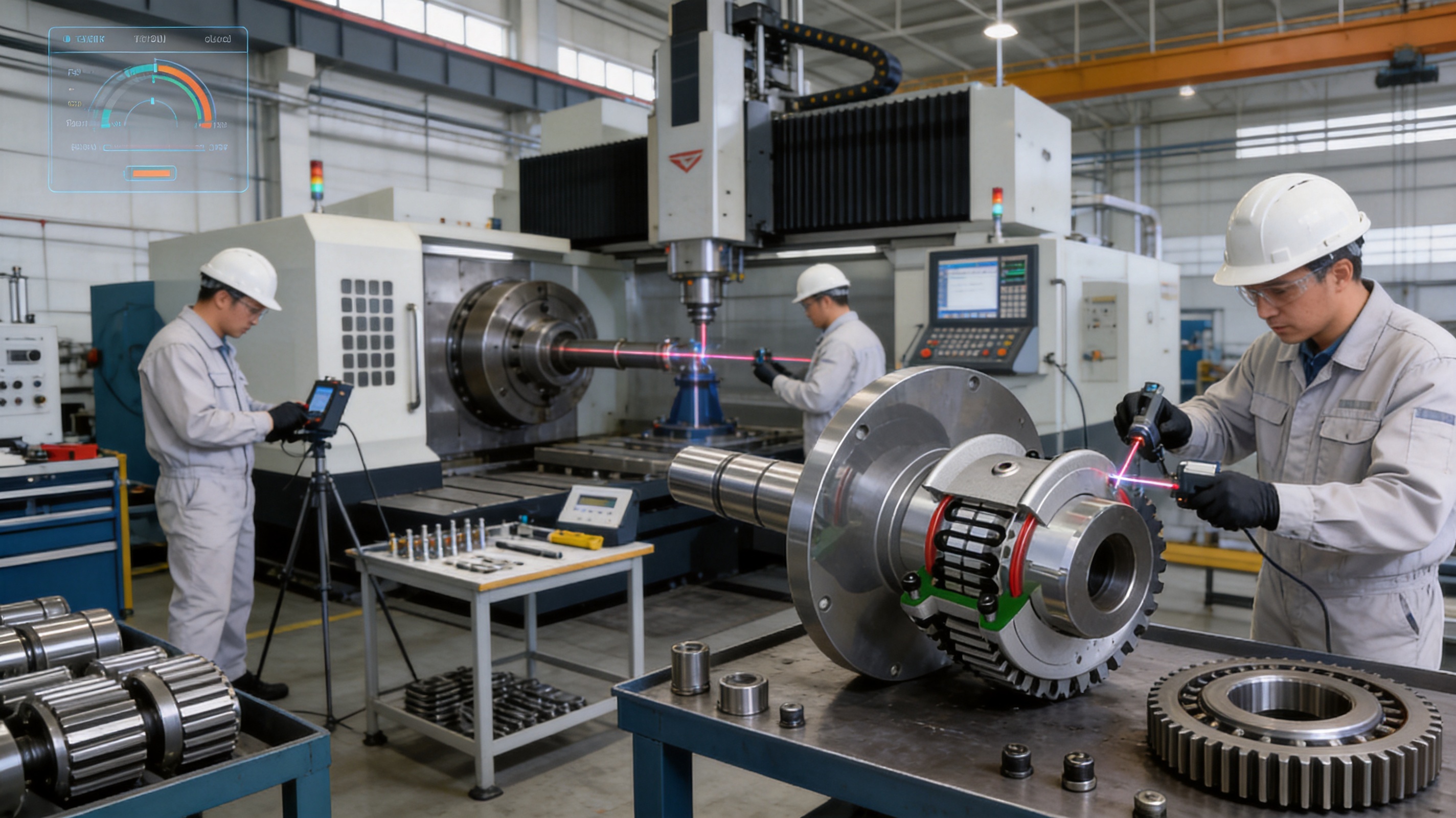
Modern industrial machinery increasingly requires transmission components that can do more than connect two shafts. A coupling must transmit torque reliably, accommodate installation and operating misalignment, control vibration, protect connected equipment, and support safe maintenance procedures. In many heavy-duty applications, it must also allow the power flow to be interrupted quickly and predictably. The T90 snake spring coupling with clutch is designed to address these combined requirements through the integration of a flexible snake-shaped spring element and a controllable clutch mechanism.
This configuration brings together two important functions. The flexible coupling element provides mechanical compliance between the driving and driven shafts, while the clutch enables controlled engagement and disengagement of the transmitted power. Instead of treating shaft alignment, vibration control, torque transmission, and power interruption as separate design challenges, the T90 combines them into one coordinated transmission system.
The result is a coupling intended for demanding industrial environments, including mining, papermaking, port machinery, metallurgical equipment, lifting systems, water equipment, and other heavy-duty installations. Its design is particularly valuable where rotating equipment experiences shock loads, frequent starts and stops, variable operating conditions, or maintenance requirements that make controllable power separation essential.
The T90 series is manufactured by Zhongye Heavy Industry Technology (Zhenjiang) Co., Ltd., a Chinese coupling manufacturer integrating research and development, production, testing, sales, and technical support. The company provides standard and customized coupling solutions for a broad range of industrial applications. Its manufacturing capabilities, engineering experience, modern workshops, and quality-control systems support the production of flexible couplings with metal elastic elements, as well as many other coupling categories.
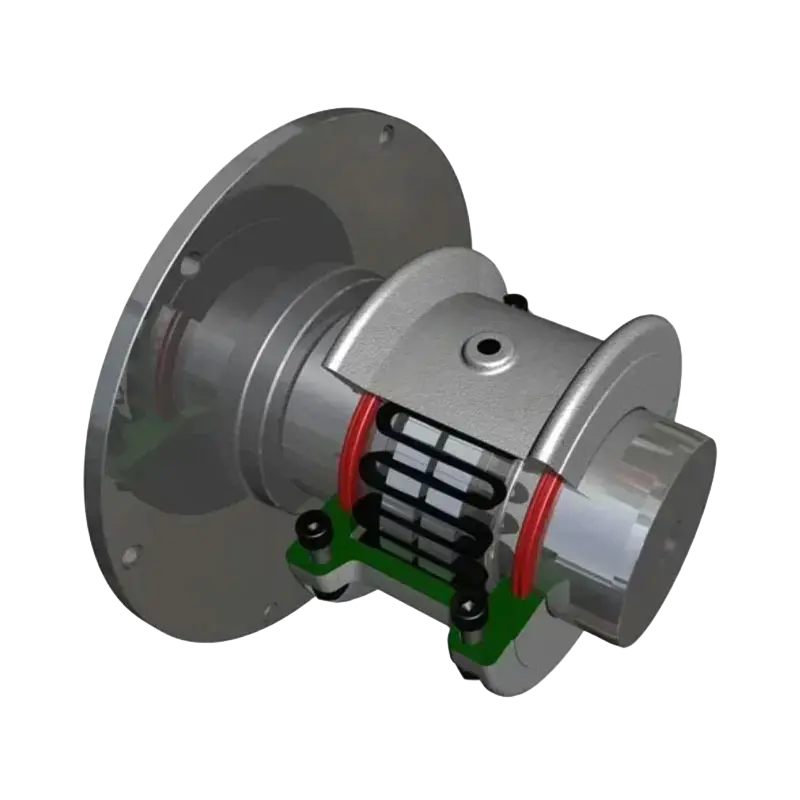
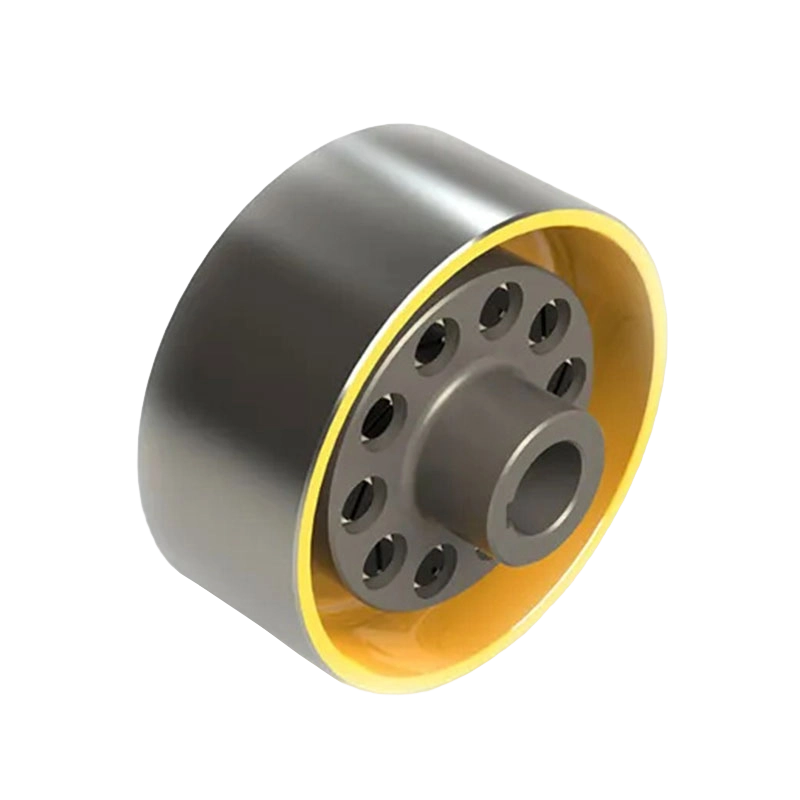
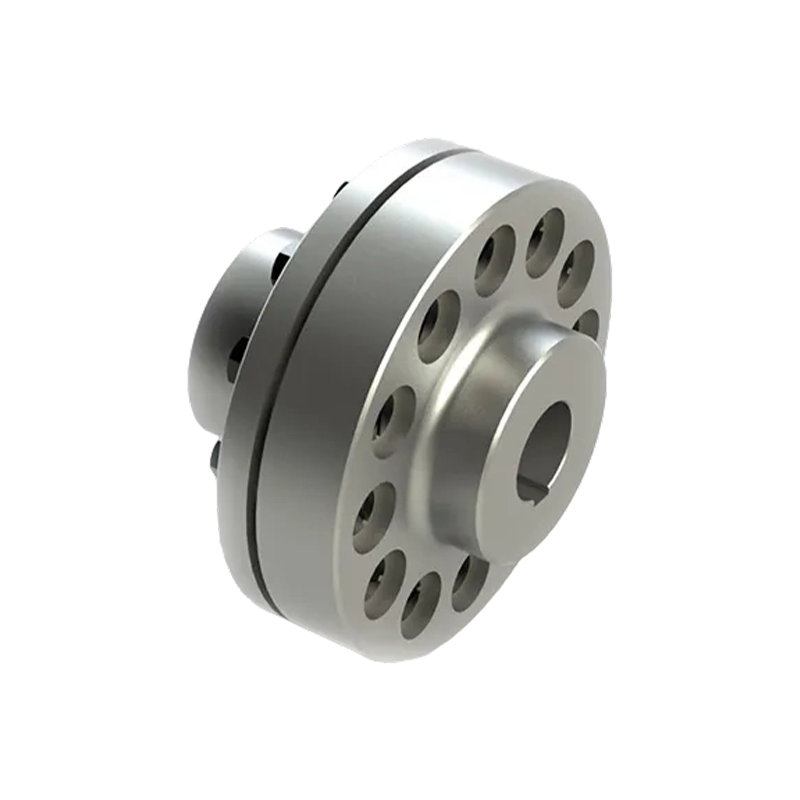
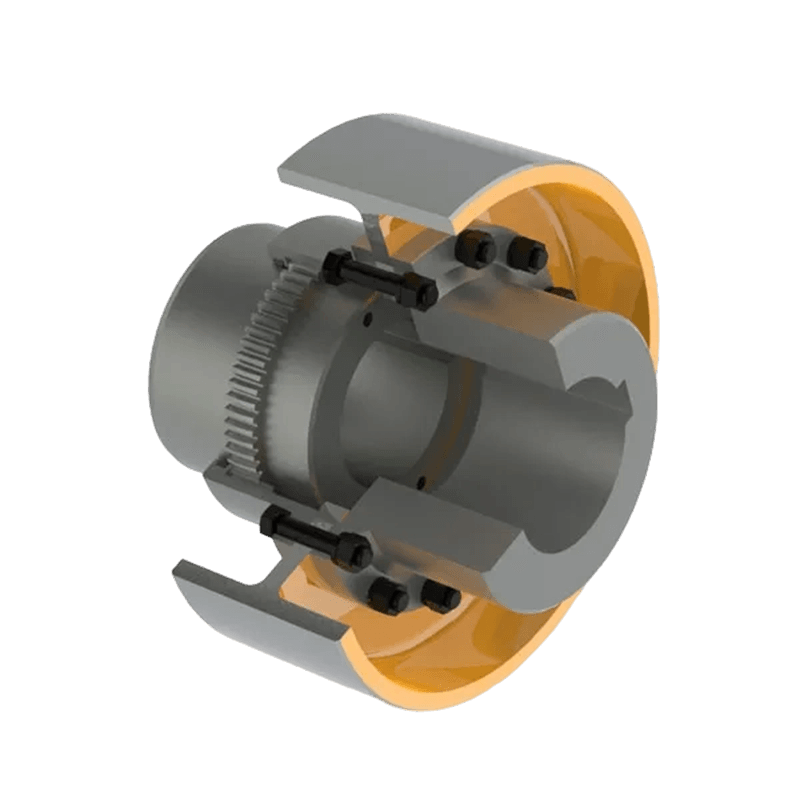
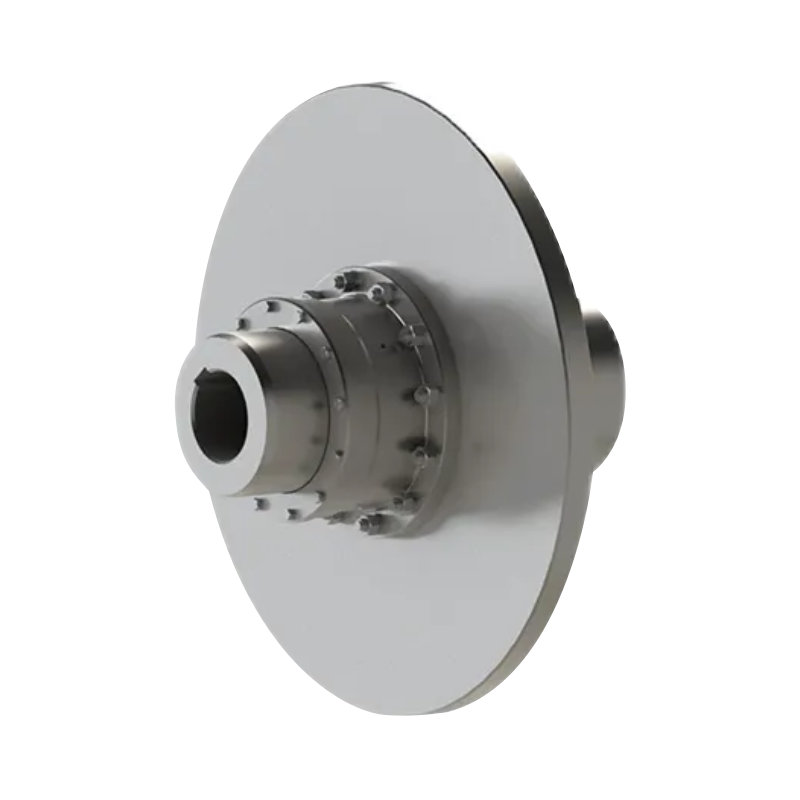
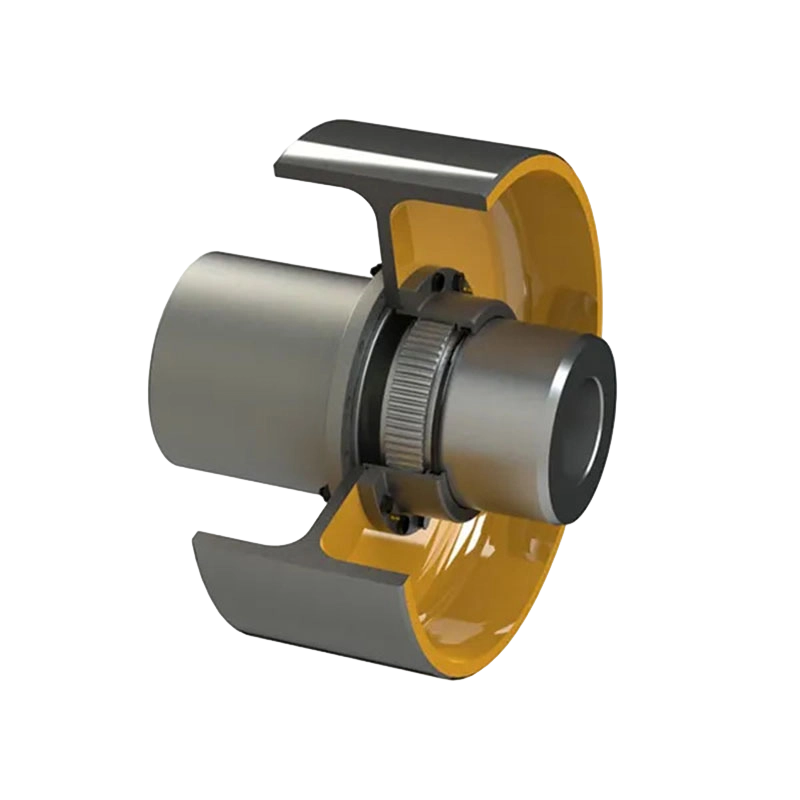
T90 snake spring coupling with clutch
1. Understanding the T90 Snake Spring Coupling with Clutch
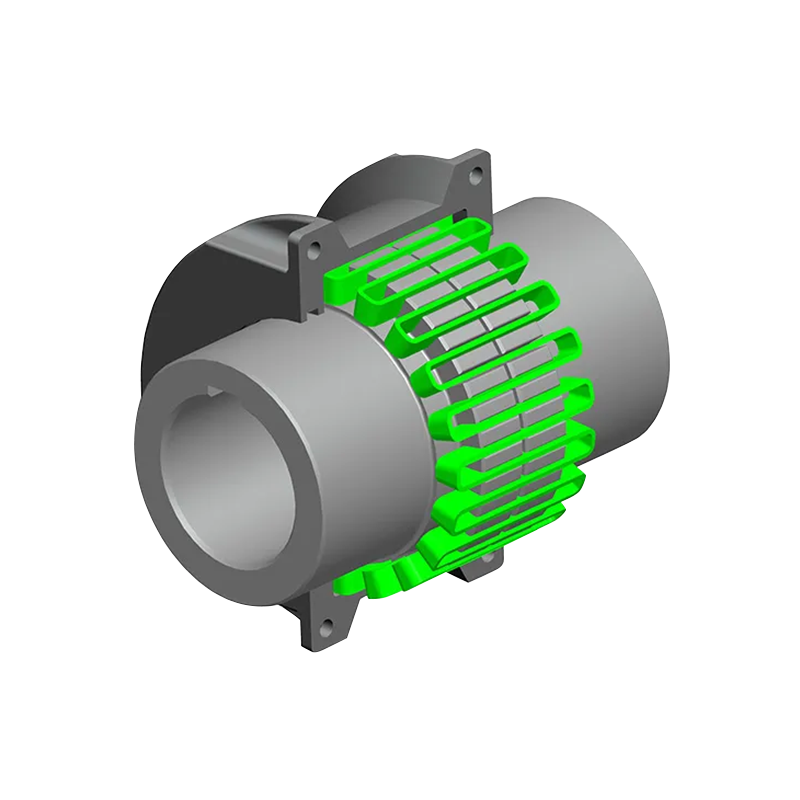
The T90 snake spring coupling with clutch is a mechanical power transmission assembly that connects a rotating drive shaft to a driven shaft while allowing controlled transmission of torque. Its primary flexible element is a snake-shaped spring arranged within the coupling housing. The spring engages with specially designed gear-like components and transfers torque through distributed contact rather than through a single rigid connection.
The snake spring acts as a metal elastic element. Under normal operation, it transmits torque while deforming slightly in response to torsional fluctuations, misalignment, and transient loads. This controlled deformation helps reduce the direct transfer of shock and vibration from one shaft to the other. The coupling can therefore provide a degree of mechanical isolation without sacrificing the high torque capacity expected from a metal coupling.
The integrated clutch adds a second functional layer. When the clutch is engaged, torque can be transmitted through the flexible coupling. When the clutch is disengaged, the drive and driven sides can be separated in a controlled manner. This feature is important for machinery that requires safe stopping, no-load starting, process changes, emergency isolation, or independent operation of connected equipment.
In a conventional flexible coupling without a clutch, stopping the driven machine often requires stopping the prime mover or using an additional mechanical disconnection device. The T90 can reduce the need for separate equipment by incorporating the power-interruption function within the coupling assembly. This may simplify the transmission layout and help reduce the number of components that must be coordinated during operation and maintenance.
The T90 is not merely a rigid connector with an added switching function. Its flexible spring structure is intended to manage real-world shaft behavior. In heavy machinery, shafts are rarely aligned perfectly under all operating conditions. Thermal expansion, foundation movement, bearing clearance, manufacturing tolerances, load changes, and structural deformation can produce angular, parallel, or axial deviations. The flexible spring helps compensate for these deviations while maintaining torque transmission.
1.1 Main operating functions
The T90 coupling with clutch performs several important functions within a power transmission system:
First, it transmits rotational torque between the prime mover and the driven machine. The spring element distributes the load across multiple contact areas and is designed for demanding torque transmission duties.
Second, it compensates for permissible shaft misalignment. This compensation reduces the bending and radial forces that would otherwise be imposed on bearings, shafts, and connected machine housings.
Third, it absorbs and moderates torsional shock. During acceleration, sudden loading, or process changes, the spring can deform elastically and reduce the severity of torque peaks.
Fourth, it helps damp vibration generated by motors, gearboxes, pumps, conveyors, compressors, mills, and other rotating machines.
Fifth, the clutch allows the user to control the connection between the drive and driven shafts. This can improve operational flexibility and may support safer equipment isolation.
Sixth, the coupling provides a compact mechanical interface in applications where space, accessibility, and system integration are important design considerations.
1.2 Why combine a clutch with a flexible coupling?
Flexible couplings and clutches traditionally serve different purposes. A flexible coupling maintains a mechanical connection while accommodating misalignment and vibration. A clutch controls whether torque is transmitted. In many machines, both functions are needed, but they are provided by separate components installed in different parts of the drivetrain.
Combining the two functions can offer practical advantages. The transmission system may become more compact, and the control of torque engagement can take place closer to the coupling interface. The integrated arrangement can also reduce the need for additional shaft extensions, support bearings, guards, and mounting structures.
For applications with frequent production changes, the clutch can permit the driven equipment to be disconnected without completely shutting down the prime mover. In a paper production line, for example, a section of auxiliary equipment may need to be isolated while upstream machinery continues operating. In a conveyor system, a drive may need to start without immediately loading the entire material-handling line. In port machinery, controlled engagement can help manage changing loads and improve the response of the transmission system.
The combined design is also useful where safety procedures require a positive and controllable interruption of mechanical power. The coupling itself does not replace all required safety devices, guarding, lockout procedures, or emergency-stop systems, but it can become an important part of an integrated safety strategy.
2. Snake Spring Technology and Its Mechanical Advantages
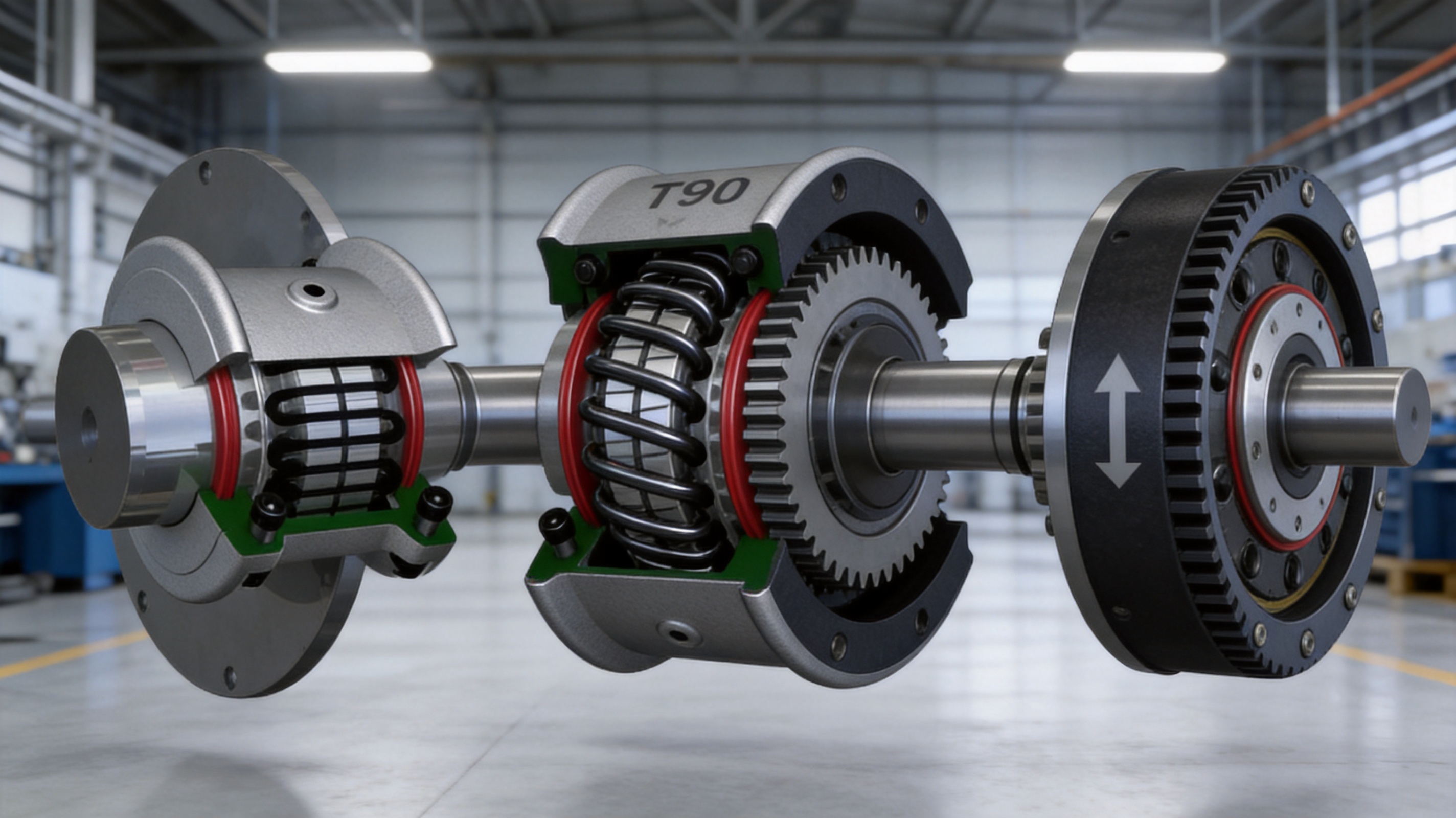
The defining feature of the T90 is its snake-shaped spring element. This spring is installed between the coupling hubs and engages with the surrounding tooth profiles. Unlike a fully rigid coupling, which transfers torque with minimal elastic compliance, the snake spring creates a controlled elastic interface between the shafts.
The spring is generally formed from high-strength metal material selected to withstand repeated cyclic loading. Its curved or serpentine geometry provides flexibility while maintaining the strength needed for torque transmission. The geometry also allows the spring to follow small relative movements between the hubs, making the coupling capable of handling several kinds of operating misalignment.
2.1 Torsional flexibility
Torsional flexibility is essential when a drive system is exposed to fluctuating torque. Motors, gearboxes, crushers, conveyors, pumps, and mills do not always experience smooth and constant loads. Starting torque, material impact, process resistance, and changes in operating speed can produce rapid torque variations.
A rigid connection transfers these variations directly into the shafts and connected equipment. This can increase the risk of fatigue, gear damage, keyway wear, bearing overload, and unexpected vibration. The T90 spring element can flex under these conditions, moderating the transfer of torsional peaks and helping the drivetrain respond more smoothly.
The spring does not eliminate torque fluctuations. Instead, it manages them within the elastic capacity of the coupling. Correct selection is therefore essential. The coupling must be sized according to nominal torque, peak torque, starting conditions, operating speed, duty cycle, alignment, environmental conditions, and the characteristics of the connected machines.
2.2 Shock absorption
Heavy industrial machinery is often exposed to impact loads. Mining equipment may process irregular or oversized material. Paper machinery may experience changes in web tension or roll resistance. Port equipment may encounter load swings during lifting, conveying, and positioning. These events can create sudden mechanical shocks.
According to the provided product information, the T90 snake-shaped spring structure can absorb up to 30% of impact energy under suitable operating conditions. The actual performance depends on the selected size, material, speed, load profile, installation accuracy, and maintenance condition. Nevertheless, the stated energy-absorption capability illustrates the central advantage of the design: the coupling is intended to reduce the severity of impact transmission to connected machinery.
By moderating shock, the spring can help protect shafts, bearings, gears, motors, and machine frames. It can also reduce the likelihood of repeated high-amplitude vibration, which is a common contributor to fatigue and premature component failure.
2.3 Misalignment compensation
Perfect alignment is difficult to maintain in large industrial installations. Even when shafts are accurately aligned during assembly, operating conditions may cause movement. Foundations can settle, housings can expand with temperature, bearings can shift slightly, and connected machines can deflect under load.
The T90 is designed to compensate for multidimensional misalignment within its permissible limits. This includes angular misalignment, parallel or radial misalignment, and limited axial displacement, depending on the specific configuration and installation conditions. The spring element allows relative movement while maintaining engagement between the coupling components.
Misalignment compensation is valuable because it reduces the secondary loads caused by rigidly forcing two imperfectly aligned shafts to rotate together. Lower secondary loading can support longer bearing life, lower shaft stress, improved running smoothness, and reduced maintenance frequency.
It is important to understand that flexibility is not a substitute for alignment. Excessive misalignment can overload the spring, increase wear, generate heat, and reduce service life. The coupling should always be installed and aligned according to the manufacturer’s technical requirements.
2.4 Vibration damping
Vibration is a major concern in rotating equipment. It can result from imbalance, gear meshing, bearing defects, motor electromagnetic forces, cyclic process loads, or structural resonance. If transmitted directly through a rigid connection, vibration can spread throughout the drivetrain.
The metal spring provides a degree of damping by allowing controlled elastic deformation. This can reduce the direct transmission of certain torsional and mechanical vibration components. The effectiveness of vibration control depends on the complete system, including shaft stiffness, machine inertia, operating speed, load variation, support structure, and resonance characteristics.
For this reason, the T90 should be selected as part of a complete drivetrain analysis rather than treated as an isolated component. When correctly matched to the system, its flexible metal element can contribute to quieter operation, lower dynamic stress, and improved equipment stability.
3. The Role of the Integrated Clutch
The clutch transforms the T90 from a continuously connected flexible coupling into a controllable transmission device. Its function is to establish or interrupt the mechanical path between the driving and driven sides. Depending on the application, clutch operation may be manual, pneumatic, hydraulic, electromagnetic, or controlled through another suitable actuation method.
The exact clutch arrangement should be selected according to the required engagement speed, available control energy, operating environment, safety requirements, and frequency of cycling. The coupling manufacturer can provide technical guidance for the appropriate configuration.
3.1 Controlled engagement
Controlled engagement helps avoid the abrupt application of full torque to the driven machine. The flexible spring already moderates torsional shock, while the clutch can provide an additional means of managing the connection process. This is useful when starting high-inertia equipment or when the driven machine must be brought into service in a controlled sequence.
Engagement behavior depends on clutch design, rotational speed difference, inertia, friction characteristics, actuation timing, and control logic. In some systems, the clutch is engaged only after the driving shaft reaches a suitable speed. In others, the clutch may be used for periodic connection and disconnection during production operations.
3.2 Controlled disengagement
Disengagement can isolate the driven machine from the prime mover. This may support maintenance planning, process adjustment, jam clearing, machine testing, and operational flexibility. The clutch should not be considered a replacement for a complete lockout and isolation procedure. Mechanical energy may remain stored in rotating components, elevated loads, flywheels, or other parts of the machine.
Properly designed and maintained clutch control can nevertheless reduce the time required to separate the drive from the driven equipment. It can also allow certain parts of a production line to be stopped without interrupting the operation of unrelated equipment.
3.3 Safety and process flexibility
Heavy machinery often requires a rapid response to abnormal conditions. A controllable coupling can support the removal of transmitted torque when a process becomes unstable or when downstream equipment must be protected. It can also assist with staged startup procedures in which different sections of a machine are brought online in a predetermined sequence.
Safety performance depends on the complete system. The clutch must be integrated with guards, sensors, emergency-stop circuits, overload protection, operator procedures, and maintenance controls. The T90 can provide a useful mechanical function within that system, but safe operation requires correct engineering and disciplined use.
4. Product Advantages Compared with Conventional Coupling Solutions
Industrial users can choose from many coupling types, including rigid couplings, gear couplings, diaphragm couplings, grid couplings, elastomeric couplings, tire couplings, chain couplings, and other flexible designs. Each type has a suitable application range. The T90 snake spring coupling with clutch is distinguished by the combination of a metal elastic element, high torque capability, shock absorption, misalignment compensation, and controllable power interruption.
| Design consideration | T90 snake spring coupling with clutch | Rigid coupling | Typical diaphragm coupling | Elastomeric coupling |
|---|---|---|---|---|
| Misalignment compensation | Provides flexible compensation within specified limits | Very limited; requires accurate alignment | Provides controlled flexibility through diaphragms | Provides flexibility through an elastomer |
| Shock-load handling | Metal spring absorbs and moderates impact loads | Transfers shock directly to the drivetrain | Suitable for many controlled-duty applications but depends on diaphragm design | Can provide good damping, subject to elastomer properties |
| Torque capacity | Suitable for demanding high-torque industrial applications | High, but with little flexibility | High for properly selected applications | Usually limited by elastomer strength and temperature |
| Integrated power interruption | Available through the clutch mechanism | Not normally integrated | Not normally integrated | Not normally integrated |
| Vibration control | Metal spring provides torsional flexibility and damping | Minimal damping | Good torsional response in suitable systems | Often strong damping, depending on material |
| Environmental durability | Corrosion-resistant material options and robust metal construction | Generally robust but sensitive to alignment stress | Can perform well but requires protection from overload and contamination | Elastomer may be affected by heat, oil, chemicals, or aging |
| Process flexibility | High because the clutch enables engagement and disengagement | Low | Usually low without separate clutch equipment | Usually low without separate clutch equipment |
4.1 Advantages over rigid couplings
Rigid couplings are simple and can transmit torque efficiently when shafts are precisely aligned and operating conditions are stable. However, they provide little tolerance for misalignment or dynamic movement. Any deviation must be absorbed by the shafts, bearings, or machine housings.
The T90 provides a more forgiving connection. Its spring element reduces the need for perfect alignment and helps protect the drivetrain against fluctuating loads. This makes it better suited to equipment where foundation movement, thermal expansion, or impact loading is expected.
The integrated clutch is another major distinction. A rigid coupling normally maintains a permanent connection unless the machine is stopped and the coupling is physically removed or disconnected. The T90 can provide controlled separation during operation, subject to the selected clutch design and safety procedures.
4.2 Advantages over conventional diaphragm couplings
Diaphragm couplings are recognized for their low-maintenance, non-lubricated operation and their ability to compensate for certain forms of misalignment. They are widely used in applications where high rotational speed, torsional stiffness, and precise motion transmission are important.
The T90 is designed with a different priority. Its snake spring focuses strongly on shock absorption, torsional compliance, high torque handling, and vibration moderation in heavy-duty applications. Compared with conventional designs that focus primarily on metal elastic compensation through diaphragms, the T90 can be advantageous where impact loads, severe duty cycles, and controllable power interruption are more important than extremely low torsional windup.
The two technologies should not be treated as universally interchangeable. Diaphragm couplings may be preferable for particular high-speed or precision applications, while the T90 may be more suitable for mining, papermaking, port machinery, conveyors, and other equipment exposed to shock and variable loading. Correct selection depends on the complete duty profile.
4.3 Advantages over elastomeric couplings
Elastomeric couplings can provide excellent vibration damping and are often compact and economical. However, elastomers may be affected by operating temperature, oil, chemicals, ultraviolet exposure, aging, and permanent deformation. Their torque capacity and service life can also change with environmental conditions.
The T90 uses a metal elastic element, which is generally better suited to high torque, high load, and harsh industrial environments. Corrosion-resistant material options can further improve durability in demanding conditions. The metal spring is also designed for repeated dynamic loading without relying on the long-term stability of a polymeric element.
Metal construction does not mean maintenance is unnecessary. The spring, hubs, housing, clutch components, fasteners, and seals still require inspection. However, the design can provide a robust alternative where elastomer aging or environmental exposure is a concern.
4.4 Advantages over separate coupling and clutch assemblies
Using separate components may provide maximum flexibility during system design, but it can also increase the number of interfaces, mounting points, and alignment requirements. A separate clutch may require additional shaft length, bearing supports, guards, and control arrangements.
The integrated T90 configuration can simplify the mechanical layout by combining flexible coupling and clutch functions in one engineered assembly. This may reduce installation complexity and make the power transmission package easier to coordinate. The actual space and cost benefits depend on the machinery design, but integration can be especially valuable when the available installation envelope is limited.
5. Suitability for Heavy-Duty Industrial Applications
The T90 is designed for applications where high torque, shock absorption, vibration control, and operational flexibility are all important. Its operating advantages are particularly relevant to machinery that cannot tolerate frequent drivetrain failures or lengthy maintenance interruptions.
5.1 Mining equipment
Mining machinery often operates under severe and unpredictable load conditions. Crushers, conveyors, feeders, screens, hoists, and processing equipment may encounter sudden resistance or impact from irregular material. Dust, vibration, temperature variations, and limited access can further increase maintenance challenges.
The T90 spring element can moderate impact loads and reduce the direct transmission of torsional shock. Its clutch can support controlled startup, equipment isolation, or process changes. Corrosion-resistant materials and robust construction can contribute to reliability in harsh working environments, provided the coupling is correctly protected from abrasive contamination and maintained according to the operating conditions.
5.2 Papermaking machinery
Paper production equipment requires precise and continuous operation. Roll drives, winding systems, pumps, fans, pulpers, and auxiliary machines may experience changes in tension, speed, or load. Unexpected vibration can affect product quality as well as machine life.
The T90 can support smooth torque transmission and help absorb fluctuations between the motor, gearbox, and driven roll or auxiliary system. The clutch can be valuable where a machine section must be disconnected for adjustment or maintenance while other equipment remains available for operation.
5.3 Port machinery
Port equipment commonly includes conveyors, ship unloaders, stackers, reclaimers, cranes, winches, and lifting systems. These machines may experience changing loads as materials are moved, lifted, positioned, or discharged. Reliable power transmission is essential because downtime can interrupt vessel handling and material flow.
The T90’s high torque capacity and impact-load management make it suitable for applications in which the drivetrain must respond to variable resistance. The clutch can assist with controlled engagement and disconnection, supporting operational sequencing and maintenance activities.
5.4 Metallurgical equipment
Metallurgical production lines often include heavy rollers, cooling systems, conveyors, mixers, shears, and material-handling systems. High temperatures, heavy loads, and repeated cycles place significant demands on couplings.
The T90 should be specified with appropriate materials, seals, guards, and thermal considerations for the installation. Its flexible metal spring can be advantageous where the transmission system experiences repeated torque fluctuation and shock. The clutch may support section isolation and controlled machine operation.
5.5 Lifting and conveying systems
Lifting and conveying equipment must manage starting torque, stopping torque, inertia, and changing payloads. Uncontrolled engagement can create sudden loads, while excessive drivetrain rigidity can transmit shock to gears, shafts, and structural components.
The T90 can contribute to smoother load application and controlled connection. However, lifting applications require careful safety engineering. Brakes, load-holding devices, overspeed protection, emergency systems, and statutory requirements must be considered independently of the coupling.
6. Engineering and Selection Considerations
Selecting the correct T90 size requires more than comparing nominal shaft diameters. The coupling must be matched to the full operating profile of the machine. Incorrect selection can result in excessive spring stress, clutch slippage, overheating, vibration, or premature wear.
6.1 Torque requirements
The first consideration is the required torque. Engineers should determine the nominal operating torque, starting torque, peak torque, reversing torque, and any transient impact loads. Service factors should be applied according to the duty cycle and the characteristics of the driven machine.
Applications with frequent starts and stops, heavy inertia, reversing operation, or impact loading generally require a higher service factor than smooth-running applications. The selected coupling should provide adequate capacity without operating continuously at the limit of its rating.
6.2 Speed and dynamic behavior
Operating speed affects centrifugal forces, spring behavior, balance requirements, and vibration. The coupling must be suitable for the maximum continuous speed as well as temporary overspeed conditions that may occur during operation or testing.
For critical systems, torsional vibration analysis may be appropriate. The coupling’s torsional stiffness and damping characteristics can influence natural frequencies and resonance behavior. The design team should evaluate the complete drive train rather than relying only on static torque calculations.
6.3 Shaft dimensions and connection method
Shaft diameter, keyway dimensions, bore tolerances, hub length, axial movement, and available installation space must be confirmed before ordering. The coupling may be supplied with different bore configurations, key arrangements, shrink-fit options, or other connection details depending on the project requirements.
The shaft and hub connection must be capable of carrying the transmitted torque without excessive fretting, keyway stress, or slippage. The manufacturer can support the selection of suitable connection details for standard or customized designs.
6.4 Misalignment limits
Angular, parallel, and axial misalignment values must be established during design and verified during installation. Flexible couplings are intended to accommodate limited movement, not compensate for severe assembly errors.
Alignment should be checked using suitable instruments and procedures. Soft foot, pipe strain, foundation movement, bearing clearance, and thermal growth should be considered. If the operating alignment differs significantly from the cold alignment, the installation procedure should account for that difference.
6.5 Environmental conditions
Temperature, humidity, dust, water, chemicals, salt spray, abrasive particles, and corrosive atmospheres can affect coupling performance. Mining and port applications may expose the coupling to dust and moisture, while paper and metallurgical equipment may involve heat, process liquids, or chemicals.
Corrosion-resistant material options and suitable protective housings can improve service life. Sealing and guarding should be selected according to the environment. The coupling should not be exposed unnecessarily to contamination that could interfere with the spring, clutch, bearings, or engagement surfaces.
6.6 Clutch operation
The clutch should be specified according to the required engagement frequency, speed difference, transmitted torque, response time, actuation method, and control system. If the clutch is expected to engage under significant speed differential, heat generation and wear must be carefully evaluated.
Control logic should prevent unintended engagement and disengagement. Sensors may be used to confirm clutch position, shaft speed, or operating status. For safety-critical systems, the clutch control should be integrated with emergency procedures and verified during commissioning.
7. Manufacturing Processes and Quality Assurance
The performance of a heavy-duty coupling depends on the quality of its materials, machining, assembly, balancing, inspection, and testing. Zhongye Heavy Industry Technology integrates research and development, manufacturing, sales, and technical support, enabling engineering requirements to be connected directly with production processes.
The company’s new workshop covers approximately 16,463.52 square meters. It includes a 5,500-square-meter heavy workshop, a 4,600-square-meter precision workshop, a 2,000-square-meter office building and gymnasium, a 500-square-meter dining hall, a 1,000-square-meter warehouse, and approximately 3,563 square meters allocated to roads, landscaping, and parking.
This production environment is organized to support both heavy fabrication and precision machining. Couplings require large-scale handling capability for housings and hubs, as well as accurate machining for bores, tooth profiles, mounting surfaces, keyways, and clutch interfaces. Separating heavy and precision work areas can help improve process organization and reduce interference between different manufacturing operations.
7.1 Engineering design and product development
Product development begins with the operating requirements of the application. Engineers evaluate torque, speed, misalignment, load variation, environmental conditions, shaft dimensions, clutch operation, maintenance access, and safety requirements. Standard models can be adapted to the customer’s installation, while non-standard designs can be developed for specialized machinery.
Computer-aided design and engineering analysis can be used to verify component geometry, clearances, stress distribution, spring engagement, clutch interfaces, and housing arrangements. Product development also benefits from experience across multiple coupling categories, including toothed couplings, elastic sleeve pin couplings, column pin couplings, universal couplings, tire couplings, jaw couplings, star couplings, diaphragm couplings, drum couplings, grid couplings, Oldham couplings, flange couplings, clip shell couplings, roller chain couplings, and safety couplings.
This broad product knowledge allows engineers to compare different coupling principles and recommend the most appropriate design for a specific drivetrain. It also supports the development of customized solutions where a standard coupling cannot meet the required dimensions or operating conditions.
7.2 Material selection
Material selection affects strength, fatigue resistance, wear performance, corrosion resistance, machinability, and service life. The coupling body, hubs, spring, fasteners, clutch components, and protective parts may require different material specifications according to their functions.
For harsh environments, corrosion-resistant materials or protective treatments may be selected. For high-load applications, the material must withstand repeated torque cycles and local contact stress. Heat treatment, surface finishing, and dimensional control may be used to improve the performance of critical components.
7.3 Heavy machining and precision machining
Large coupling components require stable machining processes to maintain concentricity and dimensional accuracy. Heavy machining operations may be used for roughing large hubs, housings, flanges, and structural parts. Precision machining then establishes the final bore dimensions, mounting faces, tooth profiles, spring seats, and clutch interfaces.
Machining accuracy is important because errors in concentricity or face alignment can create imbalance and additional dynamic loads. The manufacturing process must control tolerances throughout the component rather than relying only on final assembly adjustment.
7.4 Spring and tooth-profile accuracy
The snake spring operates through repeated contact with the coupling components. The shape, thickness, surface condition, and heat treatment of the spring influence load distribution and fatigue resistance. The mating tooth profiles must be manufactured accurately to prevent localized contact, uneven wear, and excessive stress.
During assembly, the spring must be installed with the correct engagement and clearances. Improper fitting can affect torque capacity, vibration behavior, and service life. Inspection procedures should verify that the spring and hubs meet the specified assembly requirements.
7.5 Clutch assembly and functional inspection
The clutch mechanism requires accurate installation of its friction, engagement, actuation, and positioning components. Depending on the design, inspection may include checking engagement travel, release clearance, actuation force, rotational freedom, and response consistency.
Functional testing can confirm that the clutch engages and disengages as intended. Where the application requires sensors or control interfaces, these components should also be checked for correct signal and position feedback. Any abnormal drag, interference, or incomplete release should be corrected before shipment.
7.6 Balancing and runout control
Rotating couplings must be manufactured and assembled with appropriate balance and runout control. Excessive imbalance can produce vibration that offsets the benefits of the flexible spring. Runout at the bore, hub, flange, or mounting face can also create alignment problems.
Balancing requirements depend on operating speed, coupling size, connected equipment, and applicable standards. The manufacturer can determine the appropriate balance grade for the application and perform the required inspections before delivery.
7.7 Quality management and testing
Zhongye’s products comply with international standards and certifications such as ISO 9001, according to the provided company information. A quality-management system supports process documentation, inspection planning, traceability, corrective action, and continuous improvement.
Testing may include dimensional inspection, material verification, surface inspection, hardness testing, runout measurement, assembly verification, clutch function testing, and performance checks appropriate to the product. Customers may request documentation related to materials, inspection results, testing, and conformity when required by the project.
8. Installation, Operation, and Maintenance
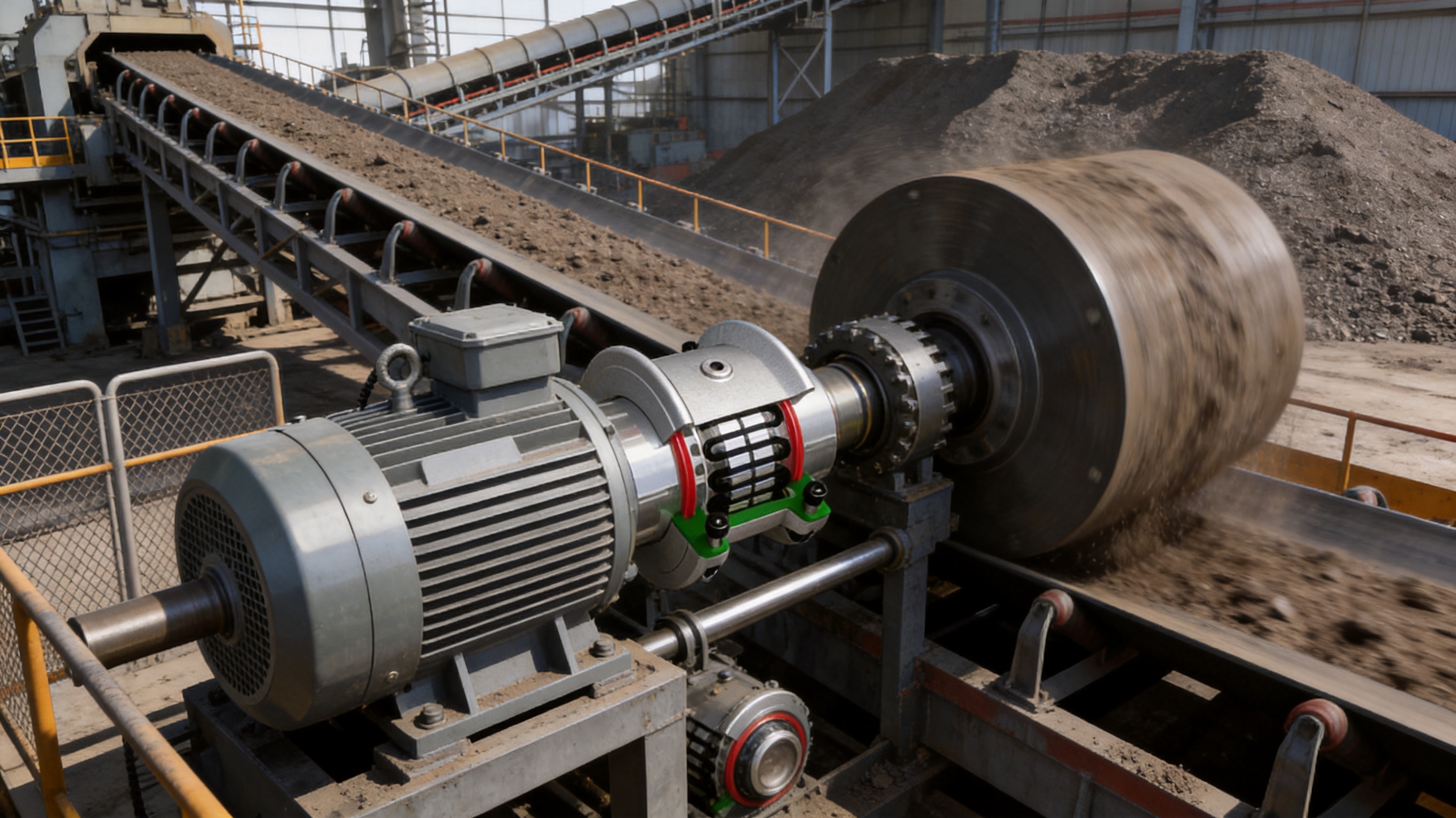
Even a well-manufactured coupling can fail prematurely if it is installed incorrectly or operated beyond its limits. Installation should be performed by qualified personnel using the manufacturer’s instructions, approved tools, and suitable measurement equipment.
8.1 Installation preparation
Before installation, inspect the coupling and confirm that all components match the order documentation. Check the shaft diameters, keyways, hub bores, mounting dimensions, clutch arrangement, and available axial space. Remove protective coatings only where necessary and keep the spring and engagement surfaces free from dirt and damage.
The shafts should be inspected for burrs, corrosion, excessive wear, and dimensional problems. Any issue that prevents proper hub seating or alignment should be corrected before assembly. The foundation and machine supports should also be checked for stability.
8.2 Alignment procedure
Alignment should address angular, parallel, and axial conditions. Dial indicators, laser alignment systems, or other appropriate equipment may be used. The shaft alignment should be checked at several rotational positions to identify runout and coupling-related deviations.
Bolts should be tightened in a controlled sequence and to the specified torque. The coupling should rotate freely by hand, where practical, before the machine is started. Guards must be installed before operation, and the clutch should be tested at low risk whenever possible.
8.3 Initial commissioning
During commissioning, observe the coupling at low speed or under controlled load if the machinery design permits. Check for unusual noise, vibration, heat, spring movement, clutch drag, incomplete engagement, or unexpected shaft displacement.
After the initial operating period, inspect the coupling again. Bolted connections, alignment, spring condition, clutch function, and protective components should be verified. Early inspection can identify installation issues before they develop into major failures.
8.4 Routine maintenance
Maintenance requirements depend on the exact configuration and operating environment. Routine inspections should include the following items:
Inspect the spring for cracks, deformation, corrosion, unusual wear, or localized contact marks.
Check hubs, tooth profiles, housings, keys, fasteners, and mounting surfaces for wear or looseness.
Verify that the clutch engages and releases completely and that its actuation system operates consistently.
Monitor vibration, temperature, noise, and shaft movement during normal operation.
Confirm that guards, seals, covers, and protective devices remain secure and effective.
Review alignment if the machine has experienced a foundation change, bearing replacement, overload, collision, or unusual vibration event.
Any damaged spring, clutch component, fastener, hub, or housing should be replaced with an approved part. Mixing unapproved components can alter the designed clearances, balance, or torque capacity.
8.5 Lubrication and contamination control
Lubrication requirements vary according to the specific T90 configuration. Some coupling arrangements may require grease or another lubricant, while others may use a protected or maintenance-reduced design. The correct lubricant, quantity, interval, and sealing method should always be confirmed from the product documentation.
Over-lubrication can be as undesirable as under-lubrication. Excess lubricant may create heat, leakage, or contamination, while insufficient lubricant can increase wear and friction. In dusty or wet environments, sealing and contamination control are particularly important.
9. Customization and Technical Support
Industrial equipment rarely follows one universal dimensional standard. Shaft spacing, bore size, speed, torque, clutch actuation, installation direction, guard arrangements, and environmental conditions can vary significantly from one project to another. The manufacturer therefore provides customized and non-standard coupling design services.
Customization may include special bore sizes, modified hub dimensions, different shaft connection methods, alternative clutch arrangements, corrosion-resistant materials, special coatings, customized mounting interfaces, additional instrumentation, or adaptation to restricted installation spaces.
Non-standard design should begin with complete technical information. Customers should provide motor power, speed, shaft diameter, keyway details, driven-machine type, operating torque, starting conditions, duty cycle, misalignment, ambient temperature, environmental contaminants, installation orientation, and required clutch function.
Drawings, photographs, existing coupling dimensions, machine layout information, and maintenance limitations can also help the engineering team develop a practical solution. Early consultation can prevent later changes to shafts, bases, guards, and control systems.
Zhongye’s stated strengths include strong research and development capability, manufacturing resources, testing facilities, strict quality control, complete specifications, customization support, technical assistance before sale, non-standard design solutions, and after-sale service. These capabilities are important when the coupling forms part of a large production system where component compatibility and delivery reliability are critical.
10. Why Manufacturing Capability Matters to Coupling Performance
A coupling is a precision mechanical product even when it is used in a large and rugged machine. The spring must have consistent geometry, the hubs must remain concentric, the tooth profiles must distribute load correctly, and the clutch must operate reliably throughout its service cycle. Manufacturing capability directly affects each of these factors.
A supplier with only limited fabrication resources may be able to produce a basic coupling, but complex heavy-duty products require coordinated control over design, materials, machining, heat treatment, assembly, testing, packaging, and technical support. A company that manages these activities within an integrated organization can respond more effectively to custom requirements and quality issues.
The extensive product range of Zhongye also provides practical engineering benefits. Experience with different coupling principles helps the manufacturer understand the trade-offs between flexibility, torsional stiffness, speed, lubrication, misalignment, maintenance, and shock-load capacity. This knowledge can be applied when evaluating whether the T90 is the correct solution or whether another coupling type is more suitable.
Manufacturing scale is also relevant to supply continuity. Heavy workshops, precision workshops, warehouses, inspection facilities, and experienced personnel can help support production scheduling and spare-part availability. For customers operating critical equipment, the ability to obtain technical assistance and replacement components can be as important as the initial product specification.
11. Total Value and Lifecycle Considerations
The purchase price of a coupling represents only one part of its total cost. Users should also consider installation time, alignment requirements, maintenance frequency, replacement parts, downtime risk, energy losses, and the effect of coupling performance on the service life of connected equipment.
The T90 may provide lifecycle value by reducing the transmission of shock and misalignment forces. If the coupling helps protect bearings, shafts, gears, and machine frames, the resulting reduction in repair frequency can be significant. The clutch may also reduce the need for separate power-interruption hardware and support more flexible operating procedures.
Metal elastic elements can be advantageous in environments where elastomeric components are vulnerable to heat, chemicals, aging, or excessive load. Corrosion-resistant construction can further support service life in damp, saline, or chemically aggressive conditions.
Lifecycle benefits depend on correct selection and maintenance. A coupling that is oversized may be unnecessarily expensive and can affect system dynamics. A coupling that is undersized may suffer premature failure. The most economical choice is generally the one that matches the actual torque, speed, environment, alignment, and control requirements while providing adequate service margin.
12. Recommended Application Evaluation Checklist
Before ordering a T90 snake spring coupling with clutch, the engineering team should review the following questions:
What are the motor power, nominal speed, maximum speed, and starting characteristics?
What are the nominal, peak, reversing, and impact torque values?
What type of driven machine is connected, and how variable is its load?
What are the shaft diameters, keyway dimensions, shaft spacing, and available installation envelope?
What angular, parallel, and axial misalignment may occur during operation?
How often must the clutch engage and disengage?
Will the clutch engage with a speed difference between the shafts?
What actuation method and control signals are available?
What environmental conditions exist, including dust, water, heat, chemicals, salt spray, and vibration?
Is lubrication required, and can the coupling be accessed easily for inspection?
What guards, sensors, brakes, emergency systems, and lockout procedures are required?
Are special materials, coatings, balancing grades, dimensions, or mounting arrangements necessary?
Providing complete answers to these questions enables the manufacturer to recommend the correct size and configuration. It also reduces the risk of changes during installation and commissioning.
13. Frequently Asked Questions
Q1: What is the primary purpose of the T90 snake spring coupling with clutch?
The primary purpose is to transmit torque between two shafts while compensating for permitted misalignment, absorbing torsional shock, reducing vibration, and providing controlled engagement and disengagement through the integrated clutch.
Q2: What makes the T90 different from a standard flexible coupling?
The T90 combines a metal snake-shaped spring element with a clutch mechanism. A standard flexible coupling may provide misalignment compensation and vibration control, but it normally does not provide an integrated means of interrupting the mechanical power connection.
Q3: Is the T90 suitable for high-torque applications?
Yes. The metal spring structure and robust construction are intended for demanding, high-torque industrial applications. The exact torque capacity depends on the model size, speed, duty cycle, load profile, and operating environment.
Q4: Can the coupling absorb impact loads?
The snake spring is designed to absorb and moderate impact loads. The provided product information states that the structure can absorb up to 30% of impact energy under suitable conditions. Actual performance depends on correct selection, alignment, speed, material, and maintenance.
Q5: Does the T90 eliminate the need for shaft alignment?
No. The T90 compensates for limited operating misalignment, but accurate initial alignment remains essential. Excessive misalignment can overload the spring, increase wear, create vibration, and shorten service life.
Q6: How does the clutch improve process flexibility?
The clutch allows the driven shaft to be connected or disconnected from the drive shaft under controlled conditions. This can support staged startup, process changes, maintenance isolation, jam clearing, and operation of selected machine sections without completely stopping the prime mover.
Q7: Is the T90 a replacement for an emergency-stop or lockout system?
No. The clutch is one mechanical component within a larger safety system. Emergency stops, guards, brakes, electrical isolation, lockout procedures, and applicable safety regulations remain necessary.
Q8: How does the T90 compare with a diaphragm coupling?
A diaphragm coupling is often selected for precise, high-speed, and relatively controlled applications. The T90 focuses more strongly on shock absorption, torsional flexibility, high torque, vibration moderation, and integrated clutch operation. The best choice depends on the complete operating conditions.
Q9: Is the T90 suitable for mining and port machinery?
Yes. Its high torque capability, flexible metal spring, shock-load management, and clutch function make it suitable for many mining, conveying, lifting, and port-machinery applications. Environmental protection, correct sealing, material selection, and maintenance remain important.
Q10: Can the coupling be customized?
Yes. Customized and non-standard coupling designs can be developed for special bore sizes, shaft arrangements, mounting interfaces, materials, clutch systems, environmental conditions, and space restrictions.
Q11: What information is needed for product selection?
Important information includes motor power, speed, torque, peak loads, driven-machine type, shaft dimensions, misalignment, duty cycle, operating temperature, environmental conditions, clutch requirements, installation orientation, and available space.
Q12: What maintenance does the T90 require?
Maintenance may include inspecting the spring, hubs, tooth profiles, clutch, fasteners, seals, guards, alignment, vibration, temperature, and lubrication condition. The exact schedule and procedures should follow the manufacturer’s instructions and the actual operating environment.
Q13: Does the coupling require lubrication?
Lubrication requirements depend on the specific configuration. Some versions may require lubricant, while others may use a protected or maintenance-reduced arrangement. The correct lubricant and service interval should be confirmed from the technical documentation.
Q14: Where is the manufacturer located?
Zhongye Heavy Industry Technology (Zhenjiang) Co., Ltd. is located at No. 1 Zhongye Yingbin Avenue, Gaozi Street, Dantu Economic Development Zone, Zhenjiang City, Jiangsu Province, China.
Q15: How can technical information be requested?
Technical and commercial inquiries can be directed to the manufacturer through sales@couplingzy.com or by telephone at +86 511 8572 3800. Additional contact numbers include +86 511 8572 3900 and +86 15106109009. WhatsApp contact is available at +8615106109009.
14. Conclusion
The T90 snake spring coupling with clutch is designed for industrial systems that require more than basic shaft connection. Its metal snake-shaped spring provides torsional flexibility, impact-load absorption, misalignment compensation, and vibration moderation. The integrated clutch adds controlled power engagement and disengagement, creating a flexible transmission solution for heavy machinery and process equipment.
Compared with rigid couplings, the T90 offers greater tolerance for dynamic shaft behavior. Compared with many elastomeric couplings, its metal elastic element is suited to high torque and harsh environments. Compared with conventional flexible couplings without a clutch, it provides greater process flexibility and can simplify the transmission arrangement by combining two functions in one assembly.
Its suitability for mining, papermaking, port machinery, metallurgical equipment, lifting systems, conveyors, and other demanding applications is supported by its robust design concept and the manufacturer’s broad coupling experience. The company’s integrated research, manufacturing, precision machining, testing, customization, and technical-support capabilities further strengthen the product’s value for industrial users.
Successful application depends on correct engineering. Torque, speed, misalignment, clutch operation, environmental conditions, installation space, balance, maintenance access, and safety systems must all be considered before selection. When appropriately specified, installed, and maintained, the T90 can help improve transmission reliability, reduce mechanical stress, support safer operating procedures, and extend the service life of connected equipment.
References
1. Product information supplied for the T90 snake spring coupling with clutch, including design features, application sectors, impact-energy absorption, material characteristics, and integrated clutch operation.
2. Zhongye Heavy Industry Technology (Zhenjiang) Co., Ltd. company information, including manufacturing facilities, product range, customization capabilities, testing resources, and quality-management practices.
3. ISO 9001, Quality Management Systems—Requirements.
4. General industrial guidance on flexible coupling selection, shaft alignment, torsional vibration, balancing, installation, and preventive maintenance.
5. General mechanical power-transmission engineering principles concerning metal elastic elements, misalignment compensation, torsional shock absorption, clutch operation, and rotating-equipment safety.
Product: T90 snake spring coupling with clutch

- Quick Links
- About
- Products
- Our Service
- News & Events
- Contact
- Products Series
- Flexible Couplings with Non-Elastic Elements
- Flexible Couplings with Metal Elastic Elements
- Flexible Couplings with Non-Metallic Elastic Elements
- Safety Coupling
- Rigid Coupling
- Contact Us
- Tel : +86 511 8572 3800 +86 511 8572 3900
- Mobile : +86 15106109009
- Email : sales@couplingzy.com
- Add:No.1 Zhongye Yingbin Avenue, Gaozi Street, Dantu Economic Development Zone, Zhenjiang City, Jiangsu Province, China.


