:+86 15106109009
:sales@couplingzy.com


 English
 русский
 Español
 عربى
 Português
 Deutsch
 Türk
 Indonesia


GJC Drum Coupling for Heavy-Duty Lifting and Drum Drive Systems
Content
- 1 Product Function and Application Principle
- 2 Key Performance Advantages
- 3 Product Construction
- 4 Representative Technical Data
- 5 Why the GJC Design Is Competitive
- 6 Manufacturing and Engineering Strengths
- 7 Application Areas
- 8 Selection Guidelines
- 9 Installation Recommendations
- 10 Maintenance and Inspection
- 11 Safety Considerations
- 12 Company Manufacturing and Service Support
- 13 Frequently Asked Questions
- 13.1 What is a GJC drum coupling?
- 13.2 Which standard applies to this coupling?
- 13.3 What is the main difference between a drum coupling and a general shaft coupling?
- 13.4 What torque range is available?
- 13.5 How much angular misalignment can the coupling accommodate?
- 13.6 Can the coupling be customized?
- 13.7 What information is needed for product selection?
- 13.8 Does the coupling require lubrication?
- 13.9 Can the GJC coupling be used outdoors?
- 13.10 How should coupling wear be monitored?
- 13.11 Why should the coupling be selected together with the drum and reducer?
- 13.12 What advantages does the manufacturer offer?
- 14 Conclusion
- 15 References
- 16 Product: GJC drum coupling(Q/YJ 16028X-2018)
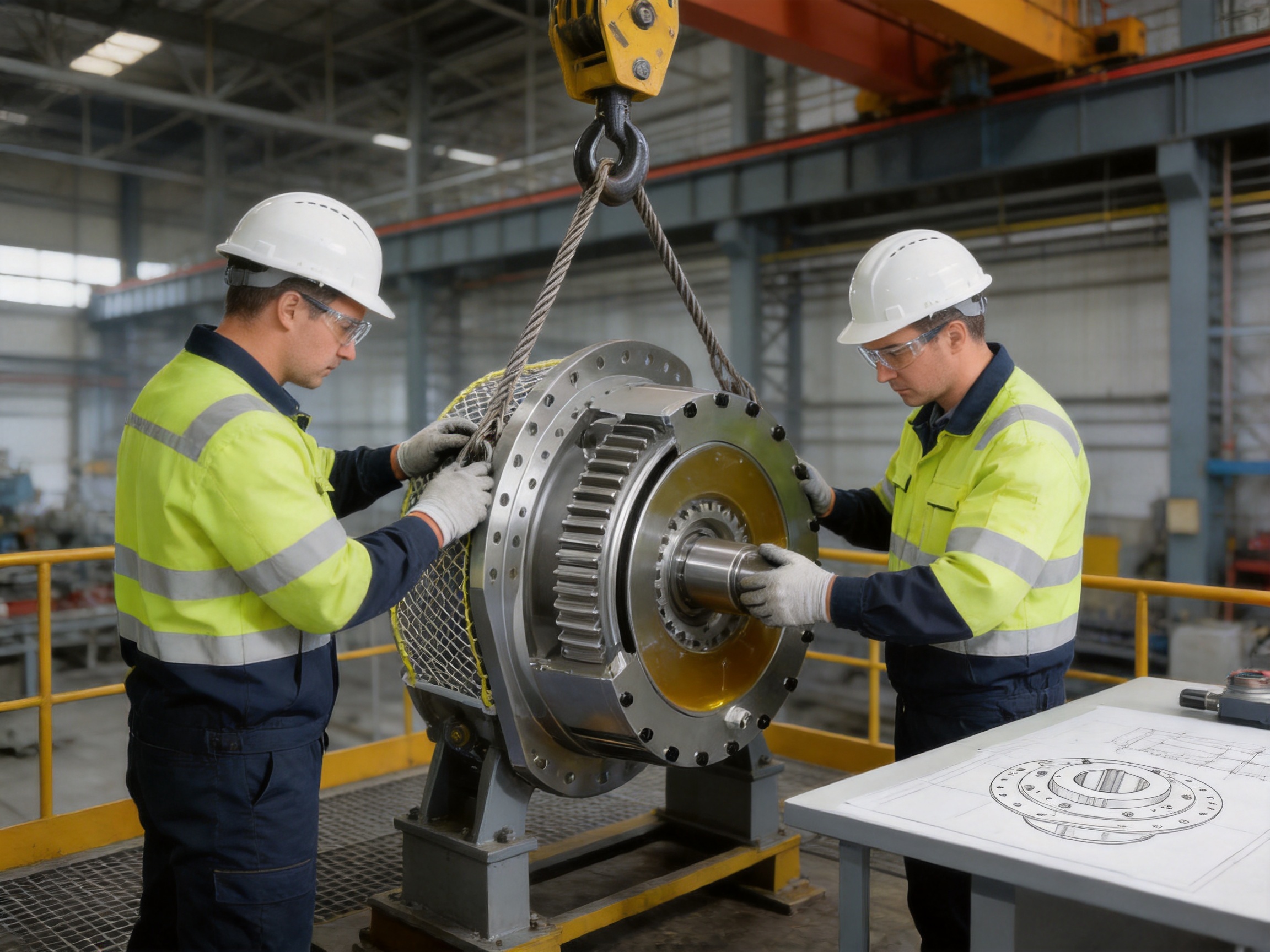
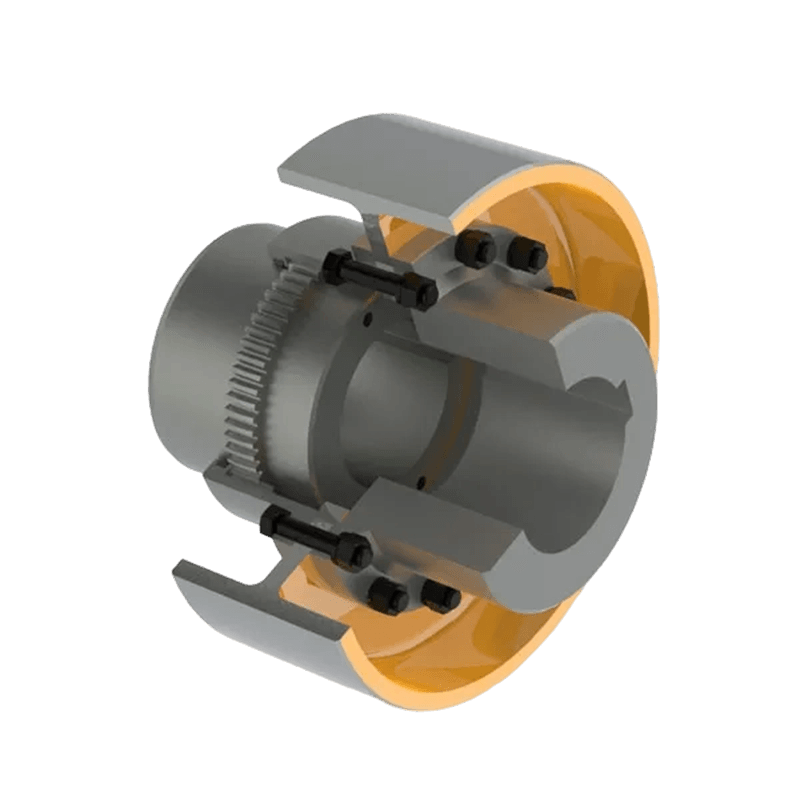
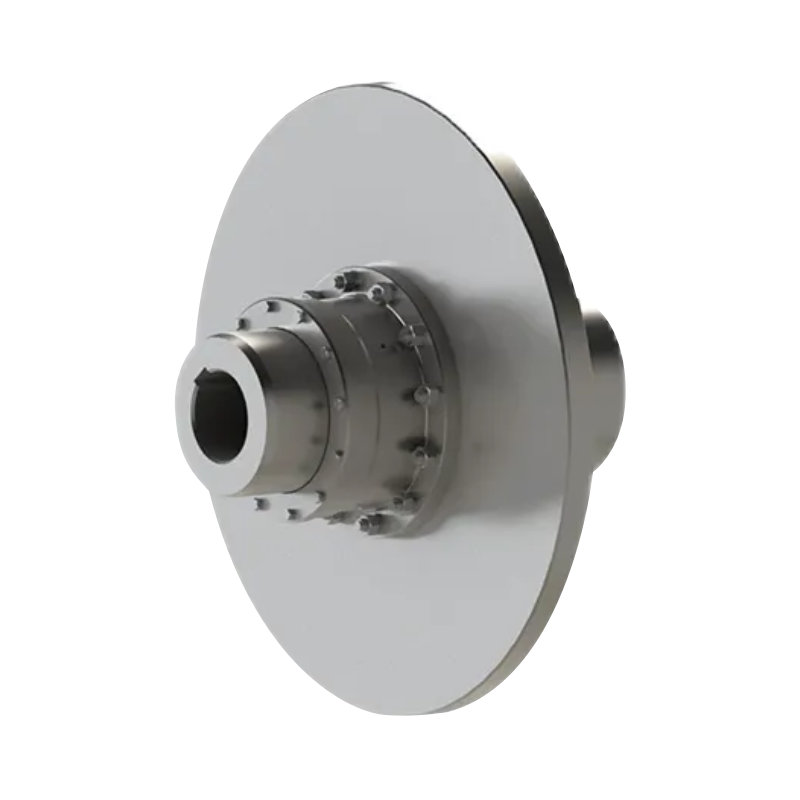
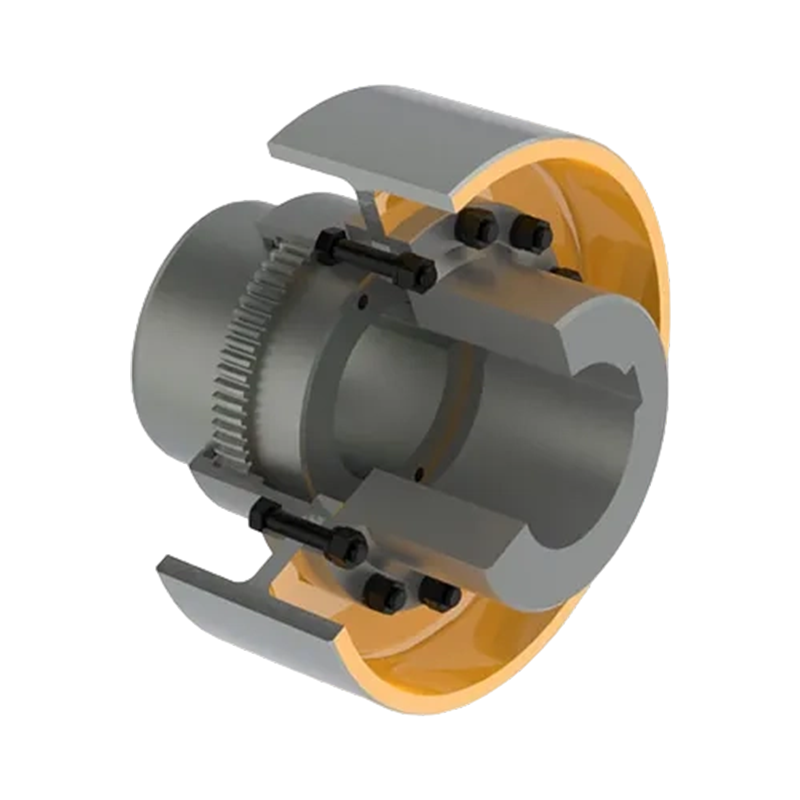
The GJC drum coupling, manufactured according to Q/YJ 16028X-2018, is a heavy-duty flexible transmission component developed for lifting machinery, crane systems, winches, reel drives, and other applications in which high torque, radial loading, shock loading, and shaft misalignment occur simultaneously. It connects a reducer output shaft to a lifting drum while allowing controlled angular movement between the connected shafts.
Unlike a rigid coupling, the GJC drum coupling can compensate for installation and operating misalignment. Unlike many conventional flexible couplings, it is specifically engineered for the structural and geometric requirements of drums used in lifting equipment. Its drum gear arrangement combines the load-bearing ability of a geared coupling with the application-specific connection features needed for crane drums.
The coupling is designed for demanding industrial environments. It can transmit nominal torques ranging from 16 kN·m to 4,000 kN·m across the listed range, with compatible shaft-hole diameters extending from approximately 110 mm to 780 mm. Depending on the model, the coupling can accommodate radial loads from 18 kN to 2,000 kN and angular compensation values of approximately ±2.5°, ±3°, or ±4°.
This broad capacity range allows the GJC series to serve compact lifting equipment as well as extremely large cranes and heavy-duty winches. The product is supported by Zhongye Heavy Industry Technology (Zhenjiang) Co., Ltd., a manufacturer integrating coupling research and development, engineering design, machining, assembly, testing, and technical service.
Product Function and Application Principle
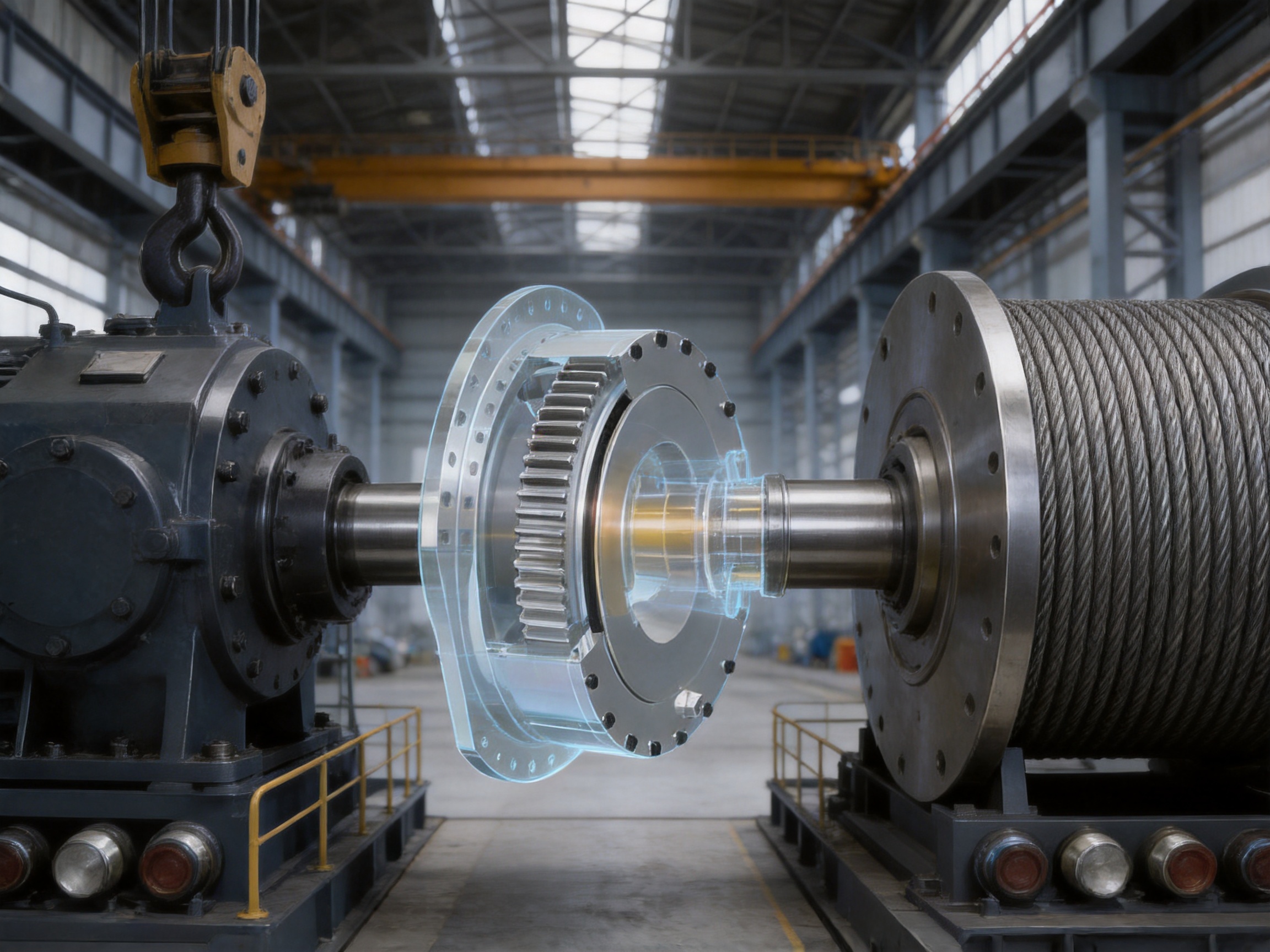
A drum coupling is installed between the output shaft of a reducer and the drum shaft or drum assembly. During operation, the reducer supplies rotational torque, and the coupling transfers that torque to the drum. The drum then winds or unwinds wire rope, chain, or another lifting medium to raise, lower, pull, or position a load.
In a practical crane installation, the reducer and drum are exposed to several sources of displacement. Manufacturing tolerances, foundation deformation, bearing clearance, thermal expansion, drum deflection, frame distortion, and uneven loading can all cause the connected shafts to move away from perfect alignment. A rigid connection would transfer these forces directly into the reducer bearings, drum supports, and coupling components.
The GJC drum coupling uses a geared flexible connection to permit limited angular displacement. This movement helps the drive system accommodate operating misalignment while continuing to transmit torque. At the same time, the coupling has a robust structural design intended to resist the high radial loads and impact forces associated with lifting equipment.
The coupling generally consists of an external gear sleeve, an internal gear ring or geared housing, sealing elements, lubrication cavities, connection flanges, and shaft connection components. The internal gear ring is commonly connected to the drum housing by bolting or welding, while the external gear sleeve is fitted to the reducer output shaft or an intermediate shaft.
The exact connection arrangement depends on the drum design, shaft dimensions, installation space, and customer requirements. Non-standard versions can be designed for special flange dimensions, shaft extensions, mounting limitations, or different drum structures.
Key Performance Advantages
High Torque Transmission Capacity
The GJC series is designed for high-torque drive systems. The listed nominal torque values increase progressively from 16 kN·m for GJC01A to 4,000 kN·m for GJC18B. This enables the same basic product family to cover a wide range of machinery, from smaller winches to large lifting systems used in ports, steel plants, mines, shipyards, and heavy manufacturing facilities.
High torque capacity is achieved through a combination of gear geometry, large effective diameters, strong connection flanges, adequate tooth engagement, and carefully selected materials. The gear components are designed to distribute the transmitted load over multiple teeth rather than concentrating the entire load at a single contact point.
This is an important advantage over simple shaft couplings that may have adequate torque ratings under smooth operating conditions but insufficient capacity for frequent starts, stops, reversals, load shocks, and emergency braking. Lifting machinery rarely operates under perfectly uniform torque. The coupling must therefore tolerate transient loads in addition to the steady operating torque.
Effective Angular Compensation
Angular compensation is one of the defining advantages of the GJC drum coupling. Many models in the smaller and medium-size range provide an angular compensation value of approximately ±2.5°. Larger models provide values of approximately ±3° or ±4°, depending on the design.
This compensation helps address angular deviation between the reducer shaft and the drum shaft. It also reduces the risk that minor alignment errors will produce excessive edge loading on gear teeth, additional bearing forces, vibration, or premature wear.
Although the coupling can accommodate angular movement, it should not be used as a substitute for proper installation. The actual shaft alignment must remain within the limits specified for the selected model. Correct installation is essential for maintaining tooth contact, reducing wear, and achieving the expected service life.
High Radial Load Capacity
Drum couplings differ from many general-purpose shaft couplings because the drum connection can produce substantial radial forces. The GJC series therefore includes radial-load ratings in its basic performance data. Listed radial load capacity ranges from 18 kN for GJC01A to 2,000 kN for GJC18B.
The radial load rating is particularly important in drum drives where the wire rope load, drum structure, bearing arrangement, and coupling position interact. A coupling with inadequate radial capacity may experience excessive deformation, gear tooth stress, seal damage, or accelerated bearing wear.
The GJC design uses a large and rigid structural arrangement intended to resist these forces. Its dimensions, flange diameter, gear size, shaft-hole diameter, and connection hardware increase with capacity. This scaling provides a practical way to select an appropriate model according to the actual lifting load and drum configuration.
Resistance to Impact and Repeated Load Changes
Crane and winch drives commonly operate with repeated acceleration, deceleration, braking, inching, reversing, and load positioning. The transmitted torque may change rapidly when a suspended load starts moving or when a brake is applied. The GJC coupling is intended for these demanding conditions.
The robust geared construction provides a rigid power path while preserving controlled flexibility. Compared with couplings using soft non-metallic elements, a metal gear coupling can offer greater resistance to high temperature, heavy compression, oil exposure, and severe mechanical impact when correctly lubricated and maintained.
The coupling is also well suited to applications in which a compact connection must transmit large torque. Its torque capacity is achieved without requiring a long elastomeric package or a large flexible membrane assembly. This can simplify integration into drum housings and restricted machinery spaces.
Reliable Lubrication and Sealing
Gear couplings depend on suitable lubrication because their tooth surfaces slide and roll against one another as angular displacement occurs. The GJC drum coupling is equipped with a sealing arrangement intended to retain lubricant in the gear chamber and prevent contaminants from entering.
Effective sealing has several benefits. It reduces lubricant loss, helps maintain an adequate film on the tooth surfaces, limits the entry of dust and moisture, and slows the progression of abrasive wear. These characteristics are valuable in steel mills, ports, mines, outdoor cranes, and other environments in which airborne particles, rainwater, scale, and process residue may be present.
Lubricant selection, filling quantity, inspection frequency, and replacement interval should follow the manufacturer’s instructions and the actual operating conditions. High ambient temperatures, frequent reversing, high speed, water exposure, and heavy shock loads may require a more frequent maintenance schedule.
Product Construction
External Gear Sleeve
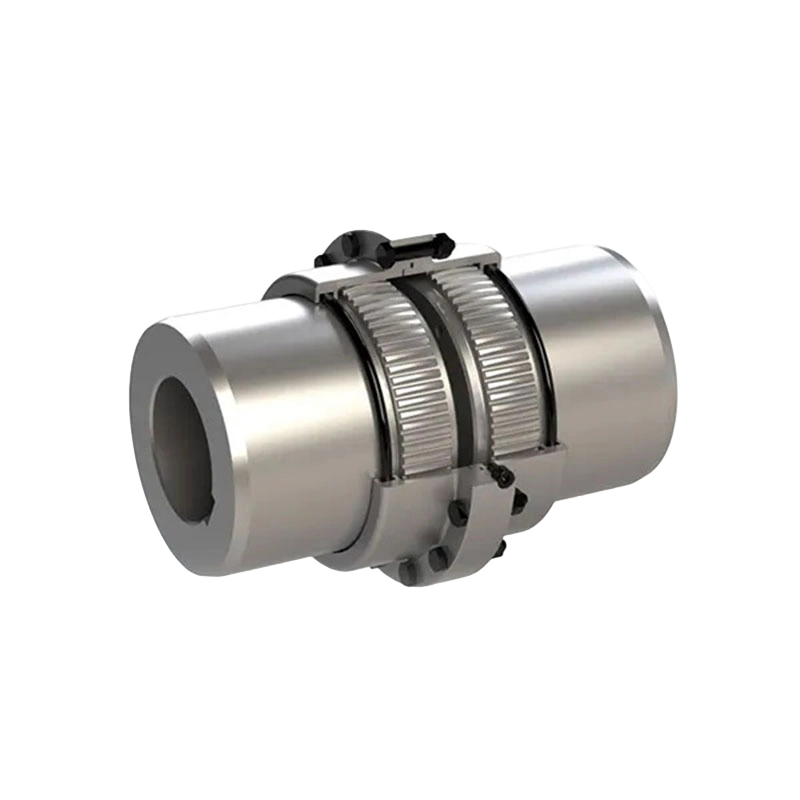
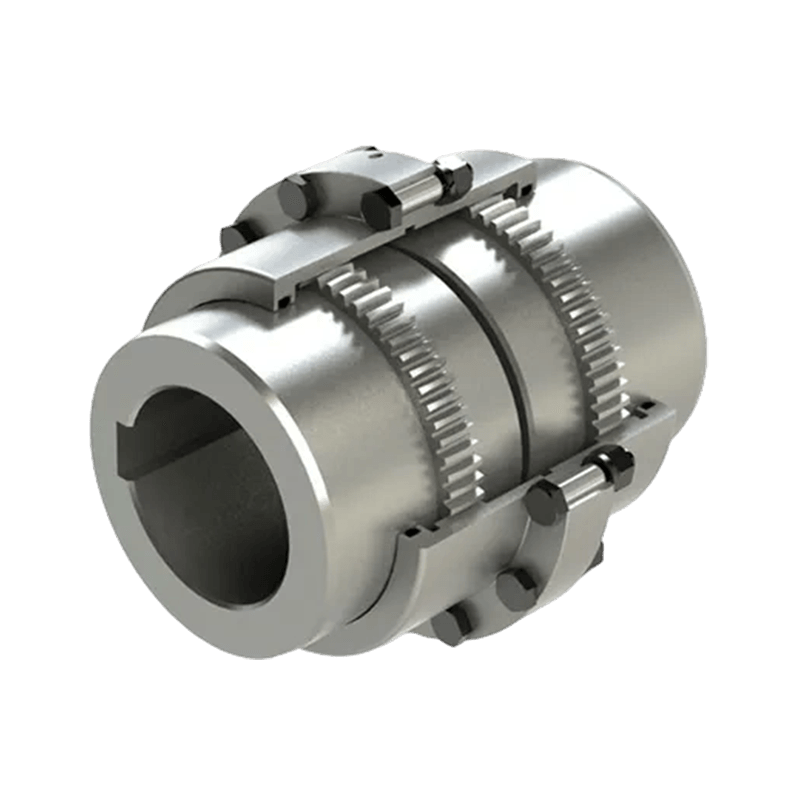
The external gear sleeve is connected to the reducer shaft or another driving shaft. Its external teeth engage with the internal teeth of the gear ring. The sleeve transfers rotational torque while allowing the required angular movement between the shaft axes.
The shaft bore, keyway, spline, or other connection detail is selected according to the customer’s shaft drawing. Standard models are available across a broad range of bore diameters and lengths, while customized shaft connections can be produced for special reducer outputs or existing equipment.
Internal Gear Ring and Drum Connection
The internal gear ring is normally connected to the drum-side structure. Depending on the equipment design, the connection can be made using bolts, a welded structure, or a purpose-designed flange. The drum connection dimensions must be checked carefully before production because the flange diameter, bolt pattern, pilot diameter, and axial location directly affect installation.
A properly designed drum connection distributes load through the full mounting flange and prevents localized deformation. The drum wall, end plate, reinforcing ring, and coupling flange should be evaluated together rather than treated as separate components.
Seals and Retaining Components
Seals retain the lubricant around the gear teeth and help shield the internal components from the outside environment. Retaining rings, covers, fasteners, and other auxiliary components maintain the intended position of the gear elements during operation.
Because lifting equipment is safety-critical, inspection should include seal condition, fastener tightness, evidence of leakage, abnormal noise, gear backlash, and visible wear. A damaged seal should be replaced promptly rather than allowing contamination to remain inside the gear chamber.
Connection Hardware
The specification table identifies bolt sizes and connection patterns for each product category. Smaller models commonly use M16 or M20 hardware, medium models use M20 or M24 hardware, and larger models use M30 or M36 hardware. The correct bolt grade, tightening torque, washer arrangement, and locking method should be confirmed for the final design.
Connection hardware is not a minor accessory. It carries a portion of the structural load and maintains the alignment of the drum-side components. Incorrect bolt selection or insufficient tightening can cause flange movement, fretting, hole elongation, and uneven gear engagement.
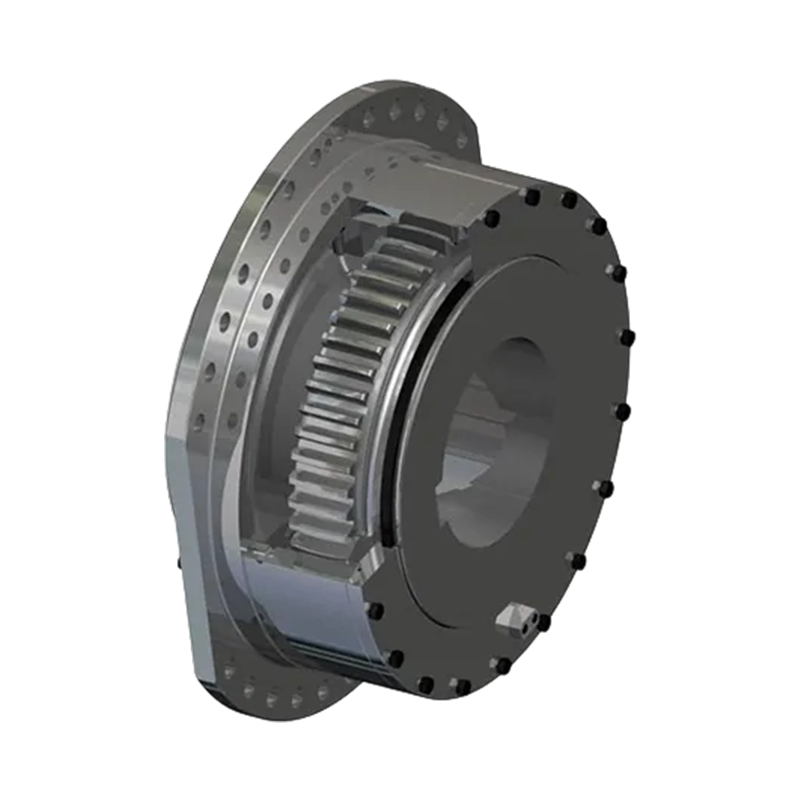
GJC drum coupling(Q/YJ 16028X-2018)
Representative Technical Data
The following table summarizes selected values from the GJC drum coupling range. The complete selection must be based on the operating torque, speed, radial load, shaft dimensions, drum connection, service factor, and installation arrangement. Dimensions are presented in millimeters unless otherwise stated.
| Model | Allowable speed (r/min) | Nominal torque (kN·m) | Radial load (kN) | Maximum shaft-hole diameter (mm) | Minimum shaft-hole length (mm) | Overall diameter D (mm) | Mass (kg) |
| GJC01A | 200 | 16 | 18 | 110 | 185 | 400 | 80 |
| GJC02A | 200 | 22.4 | 25 | 125 | 200 | 420 | 100 |
| GJC03A | 200 | 31.5 | 35.5 | 150 | 225 | 450 | 120 |
| GJC35A | 200 | 45 | 50 | 160 | 235 | 510 | 150 |
| GJC04A | 200 | 63 | 71 | 200 | 250 | 550 | 190 |
| GJC05A | 200 | 90 | 90 | 220 | 265 | 580 | 245 |
| GJC55A | 200 | 125 | 112 | 240 | 290 | 620 | 330 |
| GJC06A | 200 | 160 | 140 | 260 | 300 | 650 | 385 |
| GJC65A | 200 | 190 | 165 | 270 | 300 | 665 | 435 |
| GJC07A | 200 | 250 | 180 | 280 | 310 | 680 | 485 |
| GJC08A | 200 | 315 | 224 | 300 | 345 | 720 | 550 |
| GJC09A | 200 | 450 | 280 | 340 | 380 | 780 | 650 |
| GJC10A | 200 | 560 | 335 | 380 | 420 | 850 | 890 |
| GJC11B | 200 | 710 | 450 | 420 | 420 | 950 | 1,000 |
| GJC12B | 200 | 1,000 | 600 | 460 | 440 | 1,010 | 1,225 |
| GJC13B | 200 | 1,250 | 750 | 500 | 470 | 1,090 | 1,540 |
| GJC14B | 200 | 1,600 | 900 | 540 | 490 | 1,170 | 1,922 |
| GJC15B | 200 | 2,000 | 1,100 | 580 | 510 | 1,270 | 2,395 |
| GJC16B | 200 | 2,500 | 1,300 | 640 | 540 | 1,430 | 3,370 |
| GJC17B | 200 | 3,150 | 1,600 | 700 | 570 | 1,540 | 4,170 |
| GJC18B | 200 | 4,000 | 2,000 | 780 | 600 | 1,640 | 4,930 |
The data shows that the series is not limited to one size class. The smallest models are suitable for relatively compact lifting drives, while the largest models provide the torque and radial-load capacity required by very large industrial drums. The allowable speed listed for most models is 200 r/min, while certain B variants have lower application speeds in the smaller range or are configured for specific engineering requirements. The final operating speed should always be verified against the exact model drawing and service conditions.
The table also demonstrates the relationship between capacity and physical size. As nominal torque and radial load increase, the overall diameter, shaft-hole dimensions, connection dimensions, and mass increase accordingly. This allows engineers to evaluate not only torque capacity but also installation space, supporting structure, transportation, lifting arrangements, and maintenance access.
Why the GJC Design Is Competitive
Purpose-Built for Drum Drives
Many general-purpose flexible couplings are designed primarily for two aligned rotating shafts. A drum drive has additional requirements: a large mounting flange, high radial loading, limited installation space, a connection to a cylindrical or fabricated drum structure, and frequent exposure to harsh industrial conditions.
The GJC series addresses these requirements as an integrated drum coupling rather than adapting a standard shaft coupling with a separate mounting arrangement. This application-specific design can reduce engineering compromises and simplify the connection between the reducer and the drum.
Metallic Load Path for Severe Conditions
The geared transmission path uses metallic load-bearing components. Compared with couplings that depend primarily on elastomeric inserts, the GJC design is less dependent on the long-term compression, temperature stability, and chemical resistance of a non-metallic flexible element.
This does not mean that a geared coupling is automatically suitable for every application. It still requires proper lubrication, alignment, sealing, and inspection. However, for high-torque cranes and winches, its metallic construction offers an important advantage in environments involving high loads, elevated temperatures, repeated shocks, and demanding duty cycles.
Broad Model Range
A broad model range improves the probability of selecting a coupling that matches the actual machine rather than oversizing or undersizing the connection. Oversizing may increase cost, weight, inertia, and installation difficulty. Undersizing can lead to excessive stress, accelerated wear, and unsafe operation.
The GJC range provides intermediate sizes between its smallest and largest models. This allows selection according to torque, radial load, shaft diameter, drum connection, and available space. The manufacturer can also develop non-standard variants when the standard dimensions do not match the existing equipment.
Serviceability in Restricted Locations
Crane machinery is often installed in elevated structures, enclosed machine rooms, outdoor gantries, or narrow maintenance areas. A coupling that can be accessed, inspected, lubricated, and removed without extensive dismantling can reduce maintenance time.
The GJC arrangement is intended to support practical installation and maintenance. Some configurations can be installed or disassembled axially, and the coupling structure permits adjustment within the limits of the design. The actual removal method depends on the shaft fit, key or spline arrangement, drum structure, and available clearance.
Customization Capability
Standard catalog dimensions cannot cover every crane or winch. Existing systems may have unusual shaft lengths, non-standard bolt circles, special pilot diameters, restricted radial clearance, different drum widths, or a specific reducer interface.
Customized GJC couplings can be developed after reviewing equipment drawings and operating data. Customization may include shaft-hole diameter, bore length, keyway, spline, flange thickness, bolt pattern, drum connection diameter, gear arrangement, sealing configuration, material selection, and surface treatment.
Engineering customization is most effective when the customer provides complete information at the beginning of the project. Recommended input includes motor power, reducer ratio, output speed, nominal torque, peak torque, drum diameter, wire-rope pull, radial load, shaft dimensions, operating temperature, duty cycle, braking conditions, alignment data, and available installation space.
Manufacturing and Engineering Strengths
Zhongye Heavy Industry Technology (Zhenjiang) Co., Ltd. integrates product development, manufacturing, and sales. Its product portfolio includes geared couplings, elastic sleeve pin couplings, elastic column pin couplings, universal couplings, tire couplings, jaw couplings, star couplings, diaphragm couplings, drum couplings, grid couplings, Oldham couplings, flange couplings, roller chain couplings, safety couplings, and non-standard coupling assemblies.
Dedicated Heavy Manufacturing Facilities
The company’s new workshop covers approximately 16,463.52 square meters. The facility includes a heavy workshop of approximately 5,500 square meters, a precision workshop of approximately 4,600 square meters, an office building and gymnasium, a dining hall, a warehouse, and supporting roads, green areas, and parking facilities.
A dedicated heavy workshop is particularly valuable for large drum couplings. Large gear rings and flange components require suitable lifting equipment, machine tools, floor loading, workpiece handling, and assembly space. A precision workshop supports the machining and inspection of bores, gear profiles, sealing seats, flange faces, and connection features.
Research and Development Integration
Drum coupling performance depends on the interaction between gear geometry, material strength, lubrication, sealing, shaft connection, flange rigidity, and the surrounding drum structure. An integrated research and development team can evaluate these factors together instead of treating the coupling as an isolated catalog item.
The company’s engineering capability supports both standard product selection and non-standard design. This is important when the coupling must replace an existing product, fit into a legacy crane, connect to a new reducer, or meet the requirements of a specialized drum assembly.
Precision Machining
Precision machining is essential for the functional surfaces of a drum coupling. The shaft bore must match the specified fit and maintain concentricity with the gear teeth. The flange face and pilot diameter must support accurate drum installation. The gear profile must provide appropriate tooth engagement throughout the permitted angular displacement.
Machining quality also affects vibration, noise, sealing performance, and wear. Poor concentricity can create cyclic loading. An inaccurate flange face can produce mounting distortion. An incorrect gear profile can lead to edge contact or uneven load distribution.
For this reason, manufacturing should include controlled machining processes, dimensional inspection, gear inspection, surface-quality checks, and verification of critical assembly dimensions. The required inspection plan may be adjusted according to the product size, application criticality, and customer quality requirements.
Material and Heat-Treatment Control
Gear components in heavy-duty couplings must resist tooth bending, surface fatigue, impact, and wear. Appropriate material selection and heat treatment are therefore important parts of the manufacturing process. Material grades should be selected according to torque, tooth pressure, operating conditions, and required service life.
Heat treatment can improve hardness, strength, wear resistance, and fatigue performance when properly controlled. The treatment process must be compatible with the component geometry so that excessive distortion is avoided. After treatment, critical dimensions should be checked and corrected through suitable finishing operations where necessary.
Material certificates, heat-treatment records, hardness results, dimensional reports, and final inspection documents can provide traceability for important projects. Documentation requirements should be agreed during the quotation or order stage.
Assembly and Quality Control
Assembly quality affects the final performance of the coupling as much as machining quality. Gear elements, seals, covers, fasteners, and connection components must be installed in the correct sequence and orientation. Lubricant must be compatible with the gear and seal materials and filled in the correct quantity.
Quality control may include incoming material inspection, in-process dimensional checks, gear inspection, bore measurement, flange inspection, seal verification, assembly inspection, and final visual examination. For large or customized couplings, the manufacturer can coordinate inspection points with the customer or third-party inspector.
The company states that its products are manufactured under quality management practices associated with ISO 9001. Such systems support process control, document management, corrective action, traceability, and continuous improvement. Certification alone does not replace engineering verification, but it provides a structured framework for consistent production.
Application Areas
Overhead and Gantry Cranes
Overhead cranes and gantry cranes often use hoisting mechanisms that require high torque at low or moderate speed. The GJC drum coupling connects the reducer to the hoisting drum while compensating for movement in the crane structure. Its radial-load capability is useful where drum loads and support reactions are significant.
The coupling can be used in steel plants, fabrication workshops, warehouses, ports, shipyards, power stations, and large construction projects. Selection must account for the crane class, lifting capacity, starts per hour, duty cycle, brake torque, and emergency stopping requirements.
Winches and Hoisting Machinery
Winches used for lifting, pulling, mooring, positioning, or construction may experience frequent starts and reversals. The drum coupling provides a durable connection between the winch reducer and drum. Its flexible gear engagement helps manage shaft displacement without sacrificing the compact form required in many winch frames.
Metallurgical Equipment
Metallurgical plants expose mechanical equipment to heat, dust, scale, vibration, and heavy impact. Ladle cranes, charging cranes, rolling-mill handling systems, and coil-handling machinery require reliable power transmission under difficult conditions. A sealed, lubricated metal coupling can be advantageous in these applications when the temperature and maintenance plan are properly evaluated.
Mining and Bulk-Material Equipment
Mining equipment can involve high loads, abrasive dust, shock loading, and limited access for maintenance. Drum-driven hoists and winches used in mining operations require couplings with substantial torque and radial-load capacity. The GJC range includes large models suitable for heavy industrial drive systems.
Port and Marine-Related Equipment
Port cranes, ship loaders, unloaders, hoisting systems, and large winches often operate outdoors and under changing weather conditions. Sealing and corrosion protection become especially important. The coupling design can be adapted to the environmental requirements, while the maintenance plan should include regular checks for water ingress, lubricant condition, and external corrosion.
Paper, Water, and General Industrial Machinery
The company’s products are also used in paper equipment, water equipment, and other industrial machinery. Whenever a large drum, reel, or winding component must be driven under torque and alignment variation, the GJC design may provide a suitable engineered solution after technical review.
Selection Guidelines
Determine the Required Torque
The first selection step is to calculate the operating torque at the coupling location. The calculation should consider motor power, reducer output speed, transmission efficiency, acceleration, braking, load fluctuation, and service factor.
A basic relationship between power, speed, and torque may be used as an initial reference:
Torque in kN·m = 9.55 × power in kW ÷ speed in r/min ÷ 1,000.
This value is only a starting point. Lifting equipment requires additional consideration of dynamic factors, starting torque, emergency braking, load impact, and duty classification. The selected nominal torque rating should exceed the calculated working torque by an appropriate margin.
Check Radial Load
The radial load generated by the drum, wire rope, load, and support arrangement must be compared with the coupling’s allowable radial load. The value may not be equal to the suspended load alone. It can be influenced by drum diameter, rope angle, bearing spacing, drum deflection, and the position of the coupling relative to the drum supports.
Where the radial load is uncertain, the customer should provide a complete shaft and drum load diagram. The manufacturer can then verify the coupling selection and surrounding structural arrangement.
Confirm Shaft Dimensions
The shaft-hole diameter and length must match the reducer shaft or drum shaft. Keyway dimensions, spline details, retaining arrangements, and fit tolerances should be confirmed from engineering drawings rather than estimated from nominal shaft diameter.
Insufficient engagement length can increase contact stress and fretting. Excessive interference can complicate installation and removal. The preferred fit depends on the torque, shaft material, installation method, temperature, and whether the coupling is keyed, splined, shrink-fitted, or otherwise secured.
Review Speed and Inertia
The coupling’s allowable speed must exceed the actual operating speed. The rotating inertia of the coupling can affect acceleration, braking response, motor selection, and dynamic loads. Larger GJC models have significant mass and moment of inertia, so the drive system should be evaluated as a complete rotating assembly.
Verify Angular Displacement
The expected angular displacement should remain within the rated compensation value. Excessive misalignment can cause tooth edge contact, heat generation, seal damage, and rapid lubricant deterioration. The crane structure should be designed to maintain alignment as far as practical, with the coupling used to absorb limited operational movement rather than major structural errors.
Consider Temperature and Environment
Ambient temperature, radiant heat, water, dust, corrosive atmosphere, and chemical exposure influence material, lubricant, and seal selection. Metallurgical and foundry areas may require heat shields or special lubrication. Outdoor cranes may require enhanced corrosion protection and more frequent inspection.
Installation Recommendations
Before installation, inspect the coupling for transport damage, corrosion, contamination, and missing components. Confirm the model, bore dimensions, flange dimensions, bolt pattern, and orientation against the approved drawing.
Clean all mating surfaces and remove burrs from shafts, keyways, pilots, and flange faces. Do not strike precision gear surfaces directly with a hammer. Use suitable installation tools, lifting equipment, heating procedures, or hydraulic methods where required by the fit.
Align the reducer, drum, and coupling according to the specified tolerances. Check concentricity, axial position, angular alignment, and clearance. Confirm that the coupling can move as intended without contacting adjacent components.
Install bolts using the specified grade and tightening sequence. Tighten flange bolts progressively and diagonally to avoid distortion. Apply the specified tightening torque and use the required locking method.
Fill the gear chamber with the recommended lubricant. Do not mix incompatible lubricants. Verify that seals are correctly positioned and that no foreign particles remain inside the housing.
After installation, rotate the system slowly if possible. Listen for abnormal contact, inspect for leakage, and verify that the drum and reducer rotate smoothly. During the initial operating period, monitor temperature, vibration, noise, and lubricant leakage.
Maintenance and Inspection
Routine maintenance should include visual inspection of seals, covers, fasteners, flange connections, and surrounding structures. Look for grease or oil leakage, unusual wear particles, corrosion, cracks, loosened bolts, and deformation around the drum connection.
Gear tooth wear should be assessed according to the manufacturer’s criteria. Excessive backlash, pitting, scoring, spalling, tooth edge wear, or discoloration may indicate insufficient lubrication, contamination, overload, misalignment, or an unsuitable operating condition.
Lubricant should be replaced at the recommended interval or whenever contamination is found. Water, dust, metal particles, and burned lubricant can reduce film strength and accelerate gear damage. If a seal fails, the lubricant should be examined and the interior cleaned before refilling.
Maintenance personnel should also inspect the connected reducer and drum bearings. Coupling damage may be a symptom of a problem elsewhere in the drive system. Correcting only the coupling without correcting the underlying misalignment or overload may result in repeated failure.
For safety-critical cranes, maintenance records should identify the coupling model, inspection date, lubricant used, measured wear, replaced parts, and person responsible for the inspection. Critical findings should be reviewed before the equipment returns to service.
Safety Considerations
Lifting equipment can cause serious injury or property damage if a transmission component fails. The GJC drum coupling must be selected, installed, and maintained by qualified personnel. The coupling rating must be evaluated in relation to the full lifting system, including the motor, reducer, brake, drum, shaft, bearings, frame, rope, hook, and control system.
Never inspect or remove the coupling while the equipment is energized or supporting an unsecured load. Apply lockout and isolation procedures, secure suspended components, and follow the crane owner’s safety rules.
Protective guards should be installed around rotating coupling components. Guards should prevent accidental contact while allowing appropriate inspection and lubrication access. The guard must not interfere with the coupling’s angular movement or create additional loads.
Any modification to the gear ring, shaft bore, flange, bolt pattern, or sealing system should be approved by the manufacturer or a qualified engineer. Unauthorized machining may reduce wall thickness, weaken the component, disturb concentricity, or invalidate the original rating.
Company Manufacturing and Service Support
Zhongye Heavy Industry Technology (Zhenjiang) Co., Ltd. is based in Zhenjiang, Jiangsu Province, China. The company serves customers in metallurgical equipment, mining equipment, water equipment, lifting equipment, paper equipment, port equipment, and other industrial fields.
Its business model combines coupling design, production, sales, and technical support. This integrated structure enables the company to assist with product selection, dimensional confirmation, custom design, manufacturing, inspection, installation guidance, and after-sales support.
The company emphasizes strong research and development capability, manufacturing capacity, testing facilities, quality control, complete coupling specifications, customized engineering, pre-sale technical support, non-standard design solutions, and after-sales service.
For customers replacing an existing drum coupling, the engineering process can begin with a drawing review and dimensional comparison. The manufacturer can evaluate the original model, shaft arrangement, flange connection, operating torque, radial load, and available space before proposing a standard or customized replacement.
For new equipment, the coupling can be selected at the early design stage. Early involvement makes it easier to optimize the drum connection, reducer output shaft, bearing spacing, maintenance access, and protective guard. It also reduces the risk of discovering dimensional conflicts after the main equipment has already been manufactured.
Frequently Asked Questions
What is a GJC drum coupling?
A GJC drum coupling is a geared flexible coupling developed for connecting a reducer output shaft to the drum of lifting machinery. It transmits high torque while allowing controlled angular displacement and resisting substantial radial load.
Which standard applies to this coupling?
The product is identified as being manufactured according to Q/YJ 16028X-2018. The exact product drawing, rated values, and installation requirements should be confirmed for the selected model.
What is the main difference between a drum coupling and a general shaft coupling?
A drum coupling is designed specifically for the mechanical and structural requirements of a drum drive. In addition to connecting two rotating shafts, it provides a drum-side flange or gear-ring arrangement and is designed to handle the radial loads and installation conditions commonly associated with lifting drums.
What torque range is available?
The listed GJC range extends from approximately 16 kN·m to 4,000 kN·m nominal torque. Selection should be based on operating torque, peak torque, duty cycle, braking conditions, and an appropriate service factor.
How much angular misalignment can the coupling accommodate?
Depending on the model, the listed angular compensation is approximately ±2.5°, ±3°, or ±4°. These values are design limits and should not be treated as permission to neglect shaft alignment.
Can the coupling be customized?
Yes. Customized features may include shaft-hole size, bore length, keyway or spline, flange dimensions, bolt circle, drum connection, sealing arrangement, material, surface treatment, and special installation requirements. Engineering drawings and complete operating data are required for accurate customization.
What information is needed for product selection?
Important information includes motor power, reducer output speed, nominal and peak torque, radial load, shaft diameter, shaft length, keyway or spline details, drum diameter, drum connection dimensions, duty cycle, starts per hour, braking torque, ambient temperature, environmental conditions, and available installation space.
Does the coupling require lubrication?
Yes. The geared tooth surfaces require suitable lubrication. The lubricant type, quantity, filling method, inspection frequency, and replacement interval should follow the manufacturer’s instructions and be adapted to the operating environment.
Can the GJC coupling be used outdoors?
It can be considered for outdoor crane and winch applications when the sealing, lubricant, corrosion protection, and maintenance program are suitable for the environment. Water ingress and contamination should be controlled through regular inspection.
How should coupling wear be monitored?
Inspection should include gear tooth condition, backlash, seal condition, lubricant contamination, leakage, vibration, noise, temperature, fastener tightness, and flange deformation. Wear limits and replacement decisions should be determined according to the manufacturer’s technical criteria.
Why should the coupling be selected together with the drum and reducer?
The coupling is part of a complete drive system. Torque, radial load, shaft fit, flange rigidity, bearing arrangement, drum deflection, alignment, and braking forces interact. Selecting the coupling independently may lead to an unsuitable connection or unexpected loading on adjacent components.
What advantages does the manufacturer offer?
The manufacturer provides an integrated combination of research and development, heavy and precision manufacturing, coupling selection, custom design, quality control, technical support, and after-sales service. Its broad product portfolio also allows customers to source different coupling types from one experienced supplier.
Conclusion
The GJC drum coupling is a purpose-built solution for heavy-duty drum drives in cranes, winches, hoisting systems, and other industrial machinery. Its principal advantages are high torque capacity, substantial radial-load resistance, angular compensation, metallic geared construction, sealed lubrication, compact integration, and a broad range of standard and customized dimensions.
The series covers nominal torque ratings from 16 kN·m to 4,000 kN·m and includes models for shaft-hole diameters from approximately 110 mm to 780 mm. This range supports both relatively compact lifting equipment and large industrial cranes. Correct selection requires more than comparing torque values; engineers must also review radial load, speed, shaft geometry, drum connection, operating cycle, alignment, environment, braking, and maintenance access.
With research and development, heavy manufacturing, precision machining, quality management, inspection capability, and customized engineering support, Zhongye Heavy Industry Technology (Zhenjiang) Co., Ltd. is positioned to supply drum couplings for demanding industrial applications. When properly selected, installed, lubricated, guarded, and maintained, the GJC coupling can contribute to reliable power transmission, reduced downtime, and improved service life in heavy lifting equipment.
References
Q/YJ 16028X-2018, GJC Drum Coupling Product Standard and Technical Requirements.
GJC Drum Coupling Basic Parameters and Main Dimensions, manufacturer-provided technical data.
ISO 9001, Quality Management Systems — Requirements.
General engineering principles for flexible couplings, geared couplings, shaft alignment, lubrication, and industrial transmission equipment.
Manufacturer technical information concerning drum couplings, customized couplings, installation, maintenance, and industrial application support.
Product: GJC drum coupling(Q/YJ 16028X-2018)

- Quick Links
- About
- Products
- Our Service
- News & Events
- Contact
- Products Series
- Flexible Couplings with Non-Elastic Elements
- Flexible Couplings with Metal Elastic Elements
- Flexible Couplings with Non-Metallic Elastic Elements
- Safety Coupling
- Rigid Coupling
- Contact Us
- Tel : +86 511 8572 3800 +86 511 8572 3900
- Mobile : +86 15106109009
- Email : sales@couplingzy.com
- Add:No.1 Zhongye Yingbin Avenue, Gaozi Street, Dantu Economic Development Zone, Zhenjiang City, Jiangsu Province, China.


