:+86 15106109009
:sales@couplingzy.com


 English
  русский
  Español
  عربى
عربى  Português
  Deutsch
  Türk
Türk  Indonesia

NC Nylon Inner Gear Ring Drum Gear Coupling: Efficient, Low-Maintenance Power Transmission
Content
- 1 1. Product Overview and Operating Principle
- 2 2. Main Advantages of the Nylon Inner Gear Ring Design
- 3 3. Comparison with Conventional Coupling Technologies
- 4 4. Technical Parameters and Model Selection
- 5 5. Application Areas
- 6 6. Manufacturing Strengths and Engineering Capability
- 7 7. Installation Recommendations
- 8 8. Maintenance and Service-Life Management
- 9 9. Engineering Considerations for Competitive Selection
- 10 10. Ordering and Technical Information Checklist
- 11 11. Custom Coupling Design and Manufacturing
- 12 12. Safety Considerations
- 13 13. Frequently Asked Questions
- 13.1 Q1: What is an NC nylon inner gear ring drum gear coupling?
- 13.2 Q2: What standard does this coupling follow?
- 13.3 Q3: Does the nylon ring require lubrication?
- 13.4 Q4: What torque range is available?
- 13.5 Q5: What is the maximum allowable speed?
- 13.6 Q6: Can the coupling compensate for shaft misalignment?
- 13.7 Q7: Is the coupling suitable for high-temperature service?
- 13.8 Q8: Can the nylon gear ring be replaced separately?
- 13.9 Q9: What industries use this coupling?
- 13.10 Q10: Can the manufacturer provide customized couplings?
- 13.11 Q11: How should the coupling be protected?
- 13.12 Q12: What information is needed for model selection?
- 14 14. Why Choose This Coupling for Industrial Equipment?
- 15 15. Conclusion
- 16 References
- 17 Product: NC Nylon inner gear ring drum gear coupling(Q/YG14021X-2018)
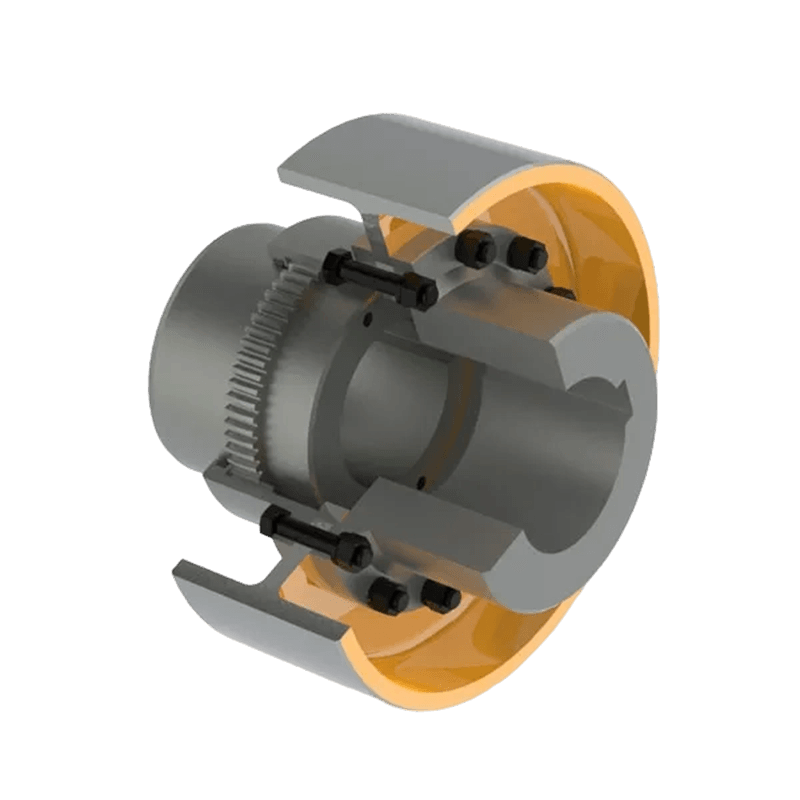
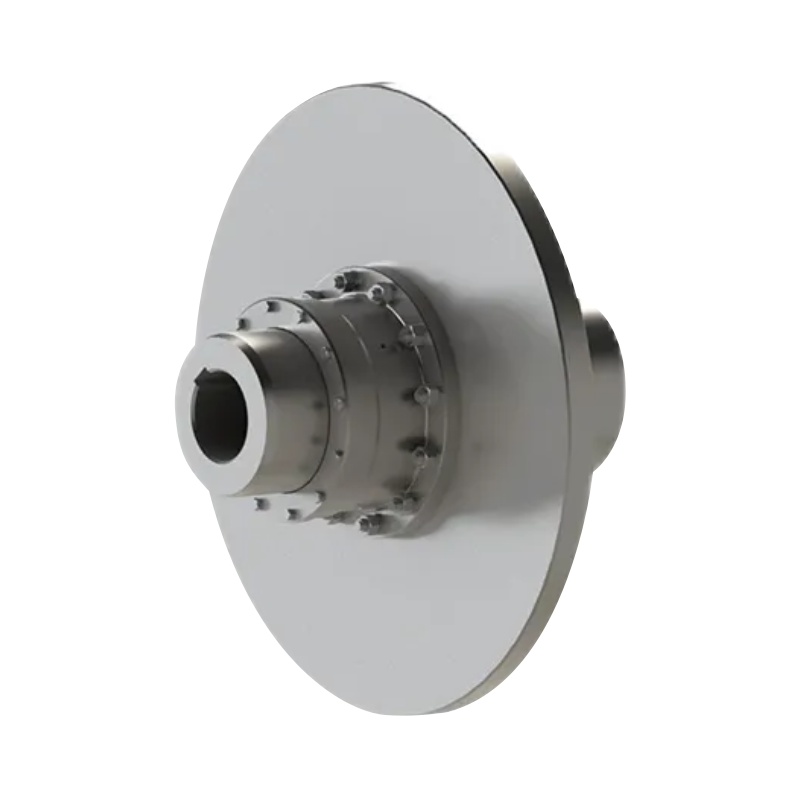
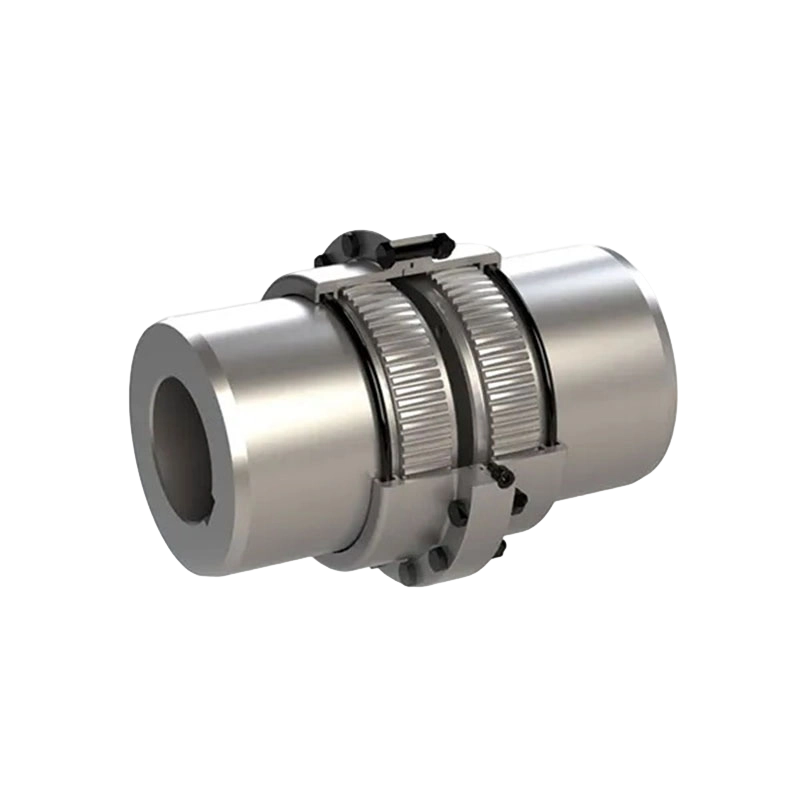
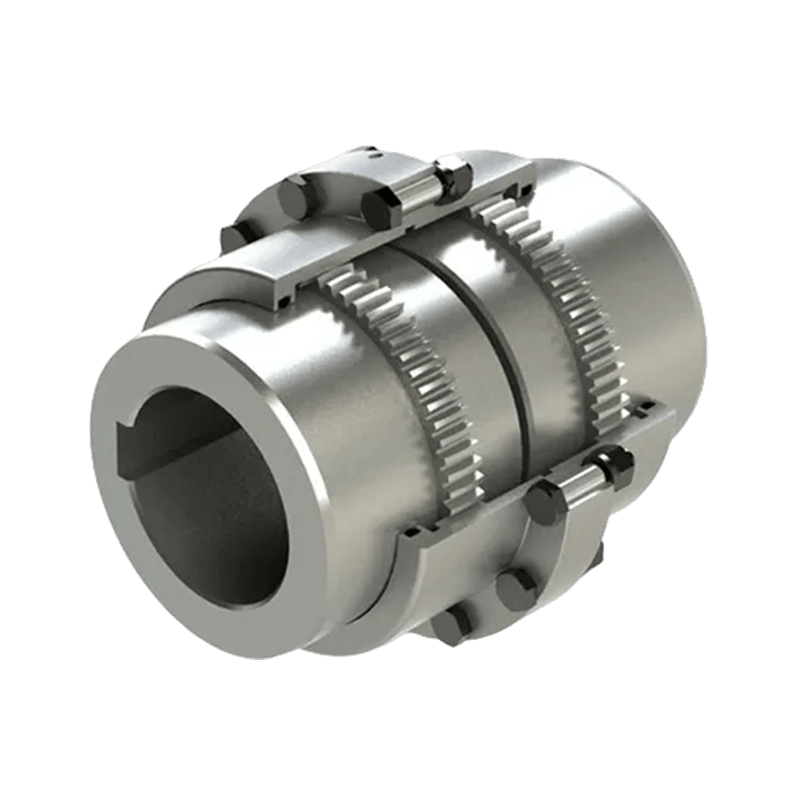
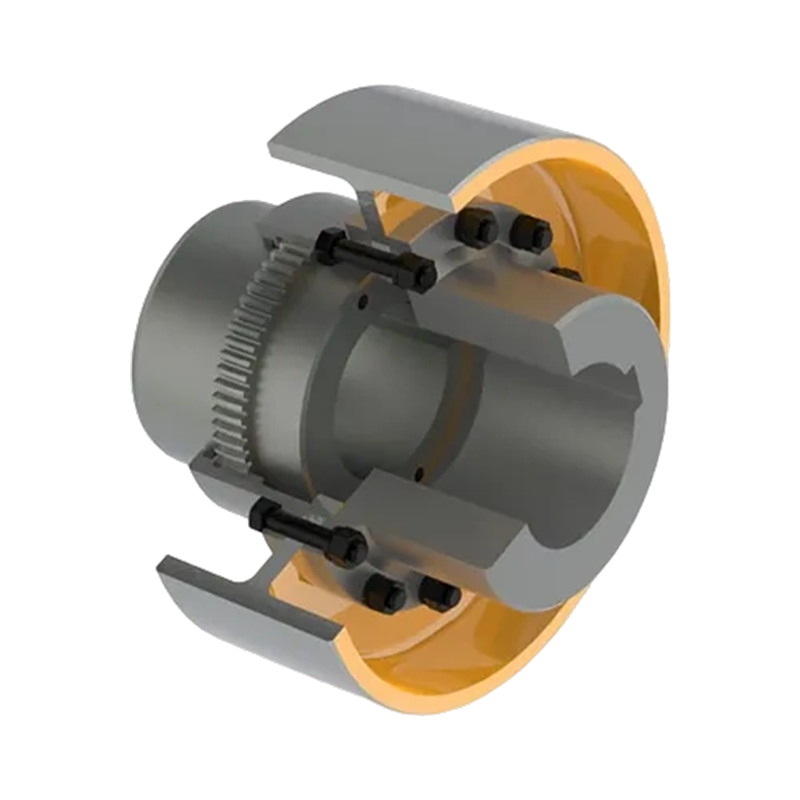
The NC nylon inner gear ring drum gear coupling, manufactured according to Q/YG14021X-2018, is a specialized flexible coupling designed for reliable torque transmission between connected shafts. It combines the strength and dimensional stability of metallic coupling components with the low-friction, wear-resistant characteristics of a nylon internal gear ring. This material combination provides an effective solution for industrial machinery that requires dependable power transmission, controlled flexibility, and reduced maintenance.
Couplings are essential components in almost every mechanical power transmission system. They connect driving and driven shafts, transfer torque, compensate for installation and operating misalignment, and help protect motors, gearboxes, pumps, rollers, and other equipment from excessive loads. The NC series is designed to perform these functions in a compact and service-friendly structure while offering a practical alternative to conventional all-metal gear couplings.
Its drum-shaped internal gear tooth design allows the coupling to accommodate angular, radial, and axial shaft displacement. This flexibility is particularly valuable in heavy industrial equipment, where thermal expansion, foundation movement, bearing clearance, shaft deflection, and installation tolerances can create misalignment during operation. By allowing controlled movement between the shafts, the coupling can reduce additional forces transmitted to connected machinery.
The product range includes NC1 through NC10, with nominal torque ratings from 40 kN·m to 3150 kN·m and allowable speeds from 1800 r/min to 6000 r/min, depending on the model. Bore sizes, shaft-hole lengths, overall dimensions, weight, moment of inertia, and allowable misalignment vary by coupling size. This broad selection supports applications ranging from compact equipment to large-scale metallurgical, mining, lifting, paper-making, port, and water-treatment machinery.
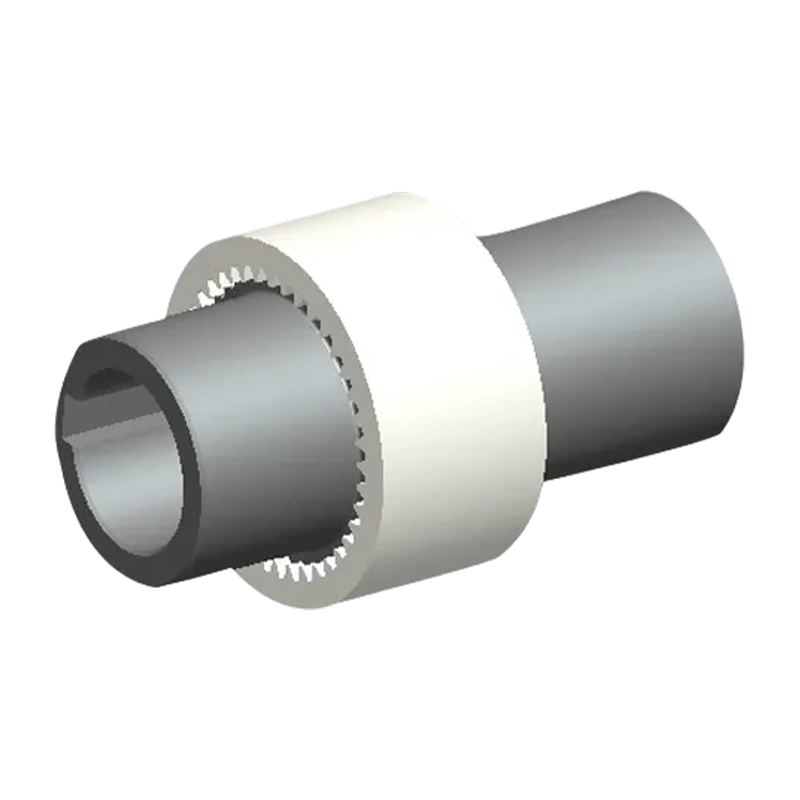
NC Nylon inner gear ring drum gear coupling(Q/YG14021X-2018)
1. Product Overview and Operating Principle
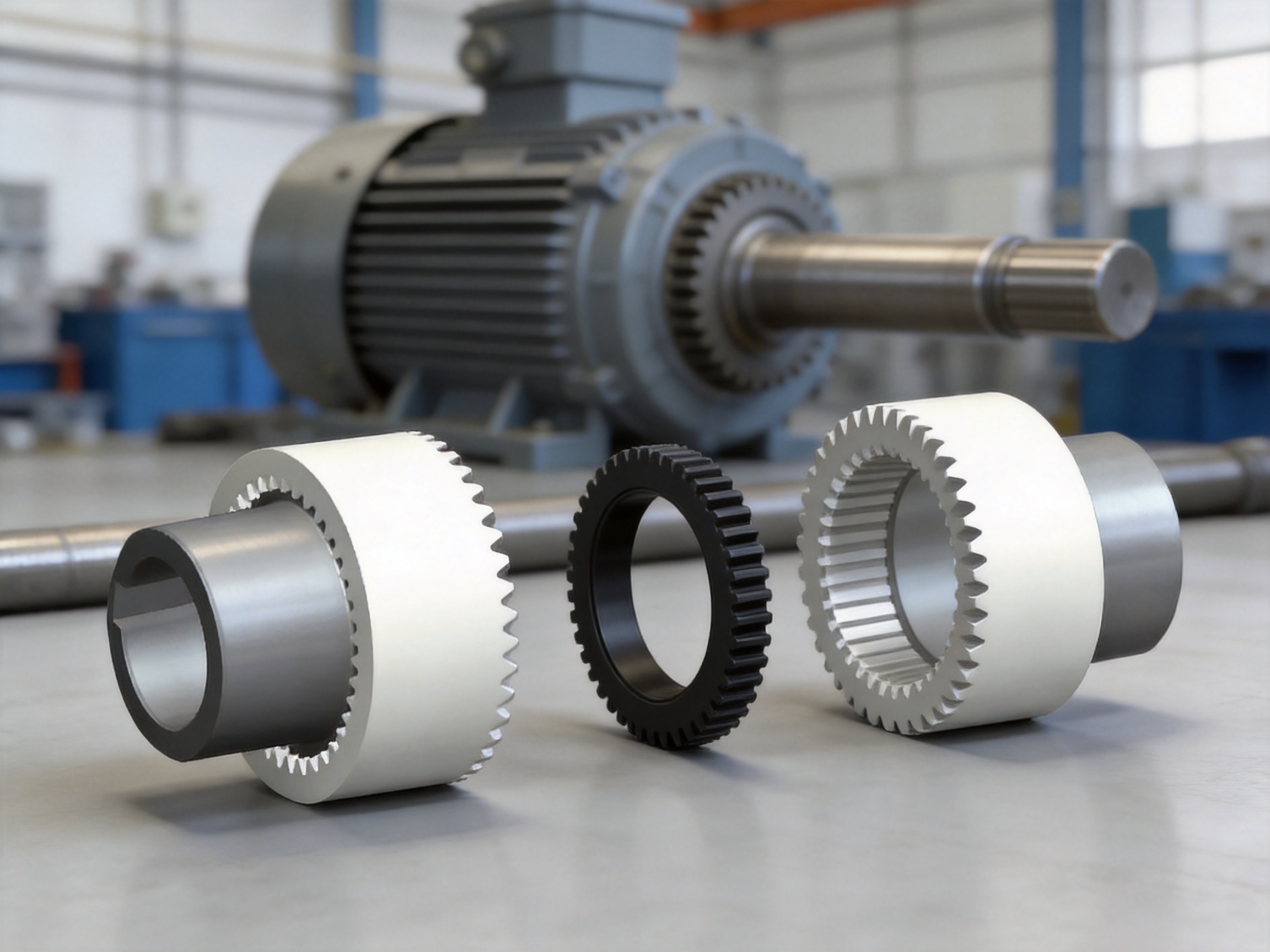
A flexible gear coupling generally consists of two hubs mounted on the respective shafts and a sleeve or ring containing internal teeth that engage with external gear teeth on the hubs. In the NC design, the nylon inner gear ring serves as the principal engaging element. Its internal teeth mesh with the external teeth of the metallic hubs, transmitting torque while permitting a limited degree of relative movement.
The tooth profile is based on a drum-shaped or crowned gear form. Unlike a straight-sided gear tooth arrangement, a crowned tooth profile provides a curved contact geometry. This geometry allows the hubs to tilt slightly within the nylon ring while maintaining effective tooth engagement. The result is a coupling that can compensate for angular misalignment without concentrating contact stress excessively at the tooth edges.
During operation, torque travels from the driving shaft into one hub, through the gear tooth engagement and nylon ring, into the opposite hub, and finally to the driven shaft. The metallic hubs provide the primary structural support for the shaft connections, while the nylon ring provides the flexible interface. The ring also helps reduce metal-to-metal contact and can contribute to quieter operation compared with some conventional all-steel gear coupling designs.
The coupling is normally installed with appropriate shaft fits, keys, retaining components, and axial positioning arrangements. The exact installation method depends on the equipment design and selected bore configuration. Before commissioning, the shafts should be aligned within the permitted axial, radial, and angular tolerances shown in the technical documentation. Correct alignment remains important even when a coupling has substantial misalignment capacity.
The NC series is structurally similar to the TGC-A type drum gear coupling. This similarity makes it suitable for users who require the operating characteristics of a drum gear arrangement but prefer a nylon internal gear ring for reduced lubrication requirements and simplified maintenance.
2. Main Advantages of the Nylon Inner Gear Ring Design
2.1 Reduced lubrication requirements
One of the most important advantages of the NC coupling is the use of a nylon inner gear ring. Nylon has inherent low-friction characteristics and can operate with less lubrication than many traditional all-metal gear coupling arrangements. Depending on the operating environment, load, speed, and manufacturer’s technical instructions, this can reduce or eliminate routine manual greasing of the internal gear interface.
Reduced lubrication is valuable in applications where access to rotating equipment is difficult or where regular shutdowns are expensive. It can also simplify maintenance planning, reduce the possibility of lubricant contamination, and lower the number of consumable materials required during the equipment life cycle.
Although the nylon element reduces lubrication requirements, users should not assume that every application is completely maintenance-free. The selected model must be evaluated for operating temperature, speed, torque, chemical exposure, contamination, and duty cycle. Inspection remains necessary, particularly in high-load or safety-critical machinery. Proper installation and adherence to the supplied maintenance instructions are essential for achieving the intended service life.
2.2 Lower operating noise
The nylon ring creates a non-metallic tooth engagement surface between the coupling hubs. This can reduce impact noise and high-frequency vibration associated with metal-to-metal tooth contact. In equipment installed near operators, production lines, or enclosed plant areas, lower coupling noise can contribute to a more comfortable working environment.
Noise reduction is also beneficial for machinery monitoring. When the coupling runs more quietly, abnormal sounds caused by misalignment, tooth wear, looseness, or bearing problems may be easier to identify during inspection. A quiet coupling does not replace vibration monitoring, but it can support more effective condition-based maintenance.
2.3 Effective misalignment compensation
All practical shaft systems experience some degree of misalignment. Angular misalignment occurs when the centerlines of two shafts intersect at an angle. Radial or parallel misalignment occurs when the centerlines remain parallel but do not coincide. Axial displacement occurs when the shafts move toward or away from each other.
The NC drum gear profile is designed to permit controlled compensation for these conditions. The coupling can accommodate angular movement through the crowned tooth engagement, while the tooth and sleeve arrangement can allow a degree of radial and axial movement. This flexibility helps reduce excessive reaction forces on motor bearings, gearbox bearings, pump bearings, and other connected components.
Misalignment compensation should be regarded as a protection and operating capability, not as permission to ignore alignment. Excessive misalignment can increase tooth pressure, generate heat, accelerate wear, and shorten the life of the nylon ring. Precision shaft alignment remains the preferred method for obtaining stable operation and long service life.
2.4 High torque capacity in a compact arrangement
The NC range provides nominal torque ratings from 40 kN·m for the NC1 model to 3150 kN·m for the NC10 model. This capacity allows the series to serve both medium-duty and heavy-duty applications. The coupling transmits torque through multiple gear teeth rather than through a single flexible element or a small number of pins, enabling an efficient load distribution when correctly selected and installed.
The compact gear engagement also allows substantial torque to be transmitted within a relatively short axial length. This is useful where machinery designers need to maintain a short shaft span or where available installation space is limited. Compared with some larger coupling arrangements, the NC design can provide a practical balance between torque capacity, overall dimensions, and service accessibility.
2.5 Protection of connected equipment
A well-selected flexible coupling does more than transmit power. It helps isolate connected machines from the effects of shaft displacement, torsional fluctuation, and installation variation. The NC coupling’s flexible nylon element and crowned tooth profile can reduce the transmission of certain impact effects and alignment-related loads.
By reducing unnecessary radial and angular forces, the coupling may help protect bearings, seals, gears, shafts, and motor components. This can contribute to lower lifecycle costs, especially in equipment where bearing replacement or gearbox repair requires a long production shutdown.
2.6 Convenient inspection and replacement
The modular construction of the NC coupling supports practical inspection. The nylon ring can be examined for tooth wear, cracking, deformation, discoloration, contamination, and other signs of deterioration. The metallic hubs can be checked for tooth damage, fretting, keyway condition, corrosion, and abnormal contact patterns.
If the nylon ring eventually reaches the end of its service life, it can generally be replaced without replacing the entire coupling assembly, provided that the hubs and other components remain within acceptable condition. This approach can reduce maintenance cost and shorten repair time compared with replacing a complete integrated unit.
3. Comparison with Conventional Coupling Technologies
3.1 Compared with all-metal gear couplings
All-metal gear couplings are widely used because they offer high torque density and strong resistance to heavy mechanical loads. However, they commonly depend on regular lubrication to maintain the gear tooth interface. If lubrication is insufficient, the teeth may experience increased friction, wear, heat generation, and surface damage.
The NC coupling offers a different balance. Its metallic hubs retain structural strength and torque transmission capability, while the nylon ring reduces the need for continuous metal-to-metal lubrication. This can be especially advantageous in dusty plants, remote installations, or production areas where routine grease application is inconvenient.
The nylon design may also produce less operating noise. In contrast, all-metal gear couplings can generate more audible gear mesh noise, particularly when tooth clearance, lubrication condition, alignment, or speed changes cause impact or vibration.
Nevertheless, all-metal couplings may be preferred in certain extreme-temperature or exceptionally aggressive-duty applications. The NC coupling should therefore be selected after considering the complete operating envelope rather than torque alone. Temperature, chemical compatibility, speed, installation conditions, and service factors should all be reviewed.
3.2 Compared with elastomeric jaw couplings
Jaw couplings use an elastomeric spider positioned between two hubs. They are compact, economical, and effective in many light- and medium-duty applications. Their elastomer can provide vibration damping and electrical isolation, but the flexible element may have a lower torque capacity than a gear coupling of comparable size.
The NC coupling is more suitable where high nominal torque, large shaft diameters, and heavy industrial duty are primary requirements. Its gear tooth transmission principle can support significantly greater torque than many compact jaw coupling designs. It is therefore a better candidate for heavy conveyors, rolling equipment, lifting machinery, and large pumps or gearboxes.
On the other hand, jaw couplings may be simpler for small motors and applications requiring a very short installation length. The correct choice depends on the actual load, speed, misalignment, environmental conditions, and maintenance expectations.
3.3 Compared with pin and bush couplings
Pin and bush couplings use flexible pins fitted with elastomeric bushes to transmit torque. They can provide useful shock absorption and moderate misalignment compensation. However, the bushes are wear components and may require periodic replacement, particularly under reversing loads, high vibration, or frequent starts and stops.
The NC coupling uses a nylon gear ring rather than a series of individual flexible bushes. Its load is distributed through the gear teeth around the circumference, supporting a robust torque path and a compact design. The absence of multiple exposed pin-and-bush positions may simplify inspection and reduce the number of individual wear parts.
3.4 Compared with diaphragm couplings
Diaphragm couplings provide high torsional stiffness, excellent speed capability, and precise angular flexibility. They are frequently used in turbines, compressors, generators, and other high-speed equipment. Their operation is generally lubrication-free, but their diaphragms can be sensitive to excessive misalignment, installation error, and overload.
The NC nylon gear coupling is oriented toward a different industrial requirement. It provides high torque capacity, practical misalignment compensation, and a durable arrangement for heavy machinery. It is particularly attractive where rugged construction and cost-effective maintenance are more important than the ultra-high-speed performance or very low backlash associated with some diaphragm coupling applications.
3.5 Compared with grid couplings
Grid couplings use a spring-like metallic grid installed between toothed hubs. They are capable of transmitting substantial torque and can provide useful torsional damping. However, they usually require lubrication and may require more detailed disassembly procedures during maintenance.
The NC coupling’s nylon ring can offer simpler maintenance and reduced lubrication requirements. It may also be less sensitive to grease leakage and contamination around the coupling guard. Grid couplings remain advantageous where high torsional damping is required, so the final selection should consider the dynamic characteristics of the drive system.
4. Technical Parameters and Model Selection
The NC series includes ten principal models. The nominal torque, allowable speed, shaft-hole range, dimensions, permitted misalignment, moment of inertia, and weight increase or vary according to the model. The following table summarizes the principal information supplied for the product range.
| Model | Nominal Torque Tn (kN·m) | Allowable Speed (r/min) | Available Shaft Hole Diameters (mm) | Allowable Axial Tolerance (mm) | Allowable Radial Tolerance (mm) | Allowable Angle | Weight (kg) |
|---|---|---|---|---|---|---|---|
| NC1 | 40 | 6000 | 6, 8, 10, 12, 14 | ±0.3 | 2 | 1° | 0.85 |
| NC2 | 100 | 6000 | 10, 12, 14, 16, 18, 20, 22, 24 | ±0.4 | 2 | 1° | 1.7 |
| NC3 | 160 | 6000 | 20, 22, 24, 25, 28 | ±0.4 | 2 | 1° | 2.6 |
| NC4 | 250 | 6000 | 28, 30, 32, 35, 38 | ±0.4 | 2 | 1° | 3.6 |
| NC5 | 315 | 5000 | 32, 35, 38, 40, 42 | ±0.4 | 3 | 2° | 5.5 |
| NC6 | 400 | 5000 | 40, 42, 45, 48 | ±0.4 | 3 | 2° | 6.8 |
| NC7 | 630 | 3600 | 45, 48, 50, 55 | ±0.6 | 3 | 2° | 9.8 |
| NC8 | 1250 | 3600 | 48, 50, 55, 60, 63, 65 | ±0.6 | 3 | 2° | 26.5 |
| NC9 | 2000 | 2000 | 60, 63, 65, 70, 71, 75, 80 | ±0.7 | 4 | 2° | 37.6 |
| NC10 | 3150 | 1800 | 70, 71, 75, 80 | ±0.7 | 4 | 2° | 55 |
The table should be used as a preliminary selection guide. Final selection requires a complete duty analysis. The nominal torque rating should not be treated as the operating torque in every situation. The designer should calculate the actual transmitted torque and apply suitable service factors for starting frequency, shock loading, reversing operation, braking, load variation, and the characteristics of the driven machine.
For a rotating drive, transmitted torque can be estimated from power and speed using the relationship T = 9550P/n when power is expressed in kilowatts, speed is expressed in revolutions per minute, and torque is expressed in newton-metres. After calculating the operating torque, the appropriate application factor should be applied before comparing the result with the coupling’s nominal torque rating.
Shaft diameter is another important selection criterion. The selected bore must accommodate the shaft diameter, keyway, fit, and required hub length. Users should verify that the available shaft-hole length is adequate for the shaft extension and that the key dimensions comply with the equipment design.
Speed must also be checked carefully. The allowable speed decreases as the coupling size increases in the NC range. For example, the smaller NC1 through NC4 models are rated up to 6000 r/min, while NC9 and NC10 are listed at 2000 r/min and 1800 r/min respectively. The operating speed should remain within the published limit and should also be evaluated for balance, guard clearance, and vibration behavior.
5. Application Areas
5.1 Metallurgical equipment
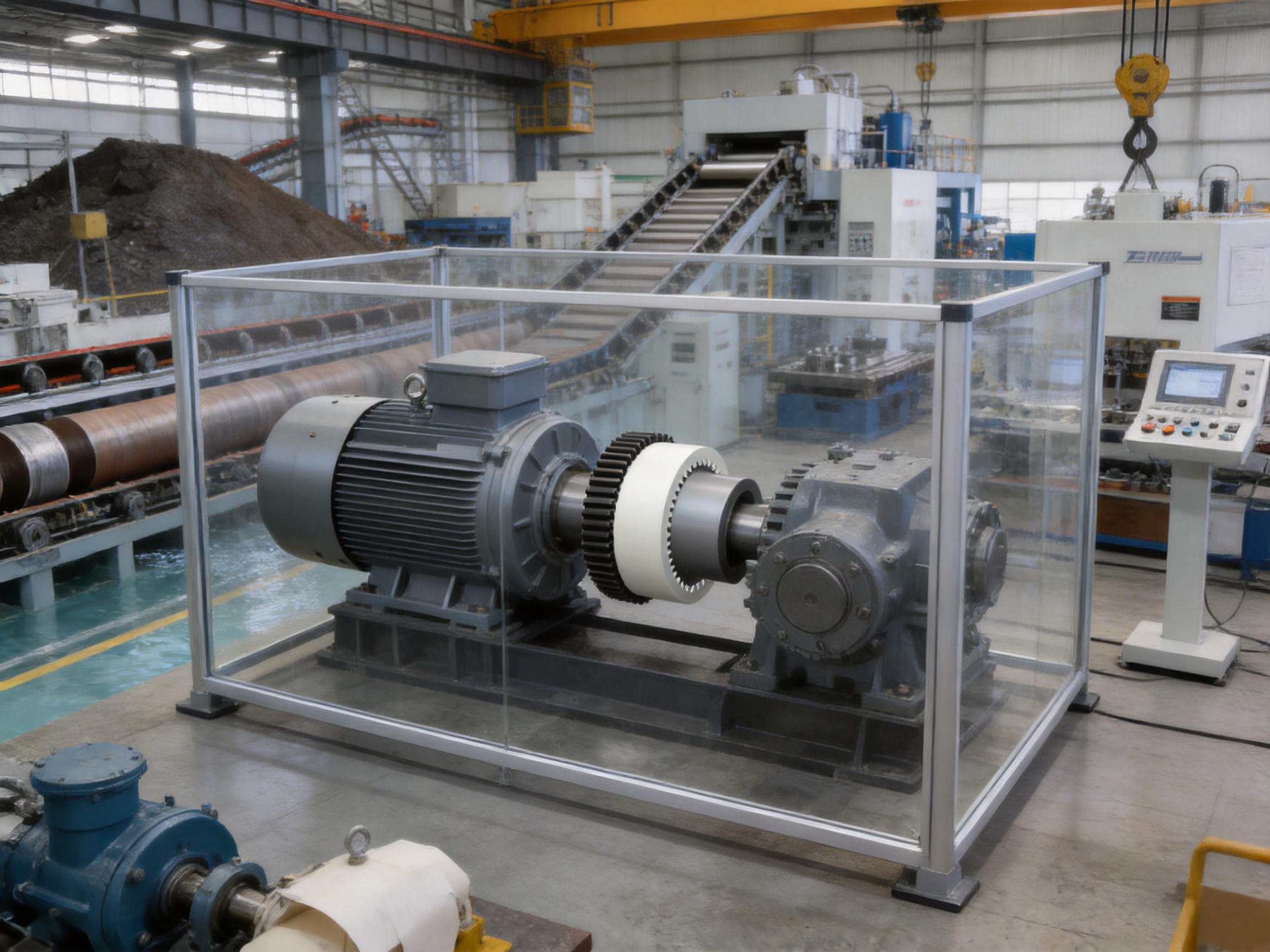
Steel mills and non-ferrous metal plants use couplings in rolling mills, conveyors, shears, coilers, feeders, cooling beds, and auxiliary drives. These machines may experience high starting torque, frequent load changes, elevated ambient temperatures, dust, scale, and vibration. The NC coupling’s high torque capacity and flexible gear engagement make it suitable for selected drive trains in these environments.
In rolling and conveying applications, correct alignment is often affected by foundation movement, thermal expansion, and repeated mechanical loading. A coupling capable of accommodating controlled misalignment can help reduce stress on connected shafts and bearings. The nylon ring may also offer practical maintenance benefits where grease application is difficult because of guarding or restricted access.
5.2 Mining and bulk-material handling
Mining machinery frequently operates under high loads and in abrasive environments. Belt conveyors, crushers, feeders, bucket elevators, screens, and hoists require dependable torque transmission and robust mechanical connections. The NC range covers multiple torque levels and bore sizes, allowing the coupling to be matched to different drive configurations.
Mining installations can be located in remote areas where maintenance resources are limited. A coupling with reduced lubrication requirements can help simplify planned service. However, adequate sealing and guarding remain necessary to prevent abrasive particles from entering the gear engagement area or damaging the coupling assembly.
5.3 Water and wastewater equipment
Water pumps, aeration systems, mixers, sludge-handling equipment, and filtration machinery depend on reliable shaft connections. In these applications, corrosion resistance, low maintenance, and stable operation are important. The non-metallic nylon ring can be advantageous in environments where moisture, chemical exposure, or water spray is present, provided the selected nylon material and metallic components are compatible with the specific environment.
For pump applications, the coupling should be selected according to motor power, pump starting characteristics, speed, shaft diameter, and alignment conditions. The coupling guard must comply with site safety requirements, and the pump and motor should be aligned after final foundation and piping work has been completed.
5.4 Lifting and hoisting machinery
Lifting equipment operates under demanding starting, stopping, braking, and reversing conditions. Cranes, winches, hoists, and other lifting systems may require a coupling with high torque capacity and reliable response to transient loads. The NC series can be considered for suitable lifting drives when the required service factor, brake torque, emergency stopping load, and safety requirements have been properly assessed.
Safety-critical lifting applications require special engineering review. The coupling should not be treated as the sole protective device. Brakes, overload protection, shaft retention, guards, inspection procedures, and applicable lifting regulations must all be addressed in the complete system design.
5.5 Paper-making equipment
Paper machines include numerous rolls, pumps, fans, dryers, cutters, conveyors, and auxiliary systems. These drives often require consistent speed, stable alignment, and low vibration. The NC coupling can be used in selected low- and medium-speed sections where its torque capacity and maintenance characteristics suit the operating conditions.
Port machinery such as ship loaders, unloaders, conveyor systems, winches, and transfer equipment may experience variable loads, frequent starts, and harsh outdoor exposure. Couplings used in these systems must tolerate vibration and environmental contamination while remaining accessible for inspection. The NC design provides a practical option for suitable drive arrangements, especially where compact dimensions and reduced routine lubrication are beneficial.
5.7 General industrial machinery
The coupling can also be used in gearboxes, fans, mixers, compressors, conveyors, machine tools, processing equipment, and other rotating systems. Its broad model range enables engineers to select a coupling according to torque, speed, shaft bore, and misalignment requirements rather than relying on a single standard size.
6. Manufacturing Strengths and Engineering Capability
The product is supplied by Zhongye Heavy Industry Technology (Zhenjiang) Co., Ltd., a manufacturer integrating research and development, production, sales, technical support, and service. The company serves industrial sectors including metallurgy, mining, water equipment, lifting, paper-making, and port machinery, where coupling reliability is directly connected with plant productivity and equipment availability.
The company’s manufacturing base covers approximately 16,463.52 square metres. It includes a heavy workshop of about 5,500 square metres, a precision workshop of about 4,600 square metres, an office building and gymnasium of about 2,000 square metres, a dining hall, warehouse facilities, and supporting roads, landscaping, and parking areas. This facility arrangement provides dedicated space for heavy fabrication, precision machining, assembly, storage, and administrative operations.
A heavy industrial coupling requires more than basic machining. Metallic hubs must be produced with appropriate material quality, dimensional accuracy, concentricity, tooth geometry, keyway accuracy, and surface condition. The nylon gear ring must also be manufactured with stable tooth form, correct internal dimensions, appropriate material properties, and consistent fit with the hubs. The company’s combination of heavy and precision workshops supports these different production requirements.
6.1 Research and development
Coupling design involves the interaction of torque, speed, shaft movement, tooth contact, material behavior, vibration, and installation conditions. An experienced technical team can evaluate these factors when developing standard and non-standard products. The company reports strong research and development capabilities and provides design support for customized coupling requirements.
Customization may include special bore sizes, keyway arrangements, flange dimensions, shaft spacing, materials, protective finishes, environmental adaptations, and non-standard torque or speed requirements. Such projects require a technical review of drawings, loading data, operating temperature, installation limitations, and applicable standards before production begins.
6.2 Precision machining and dimensional control
Precision machining is especially important for gear couplings. If the hubs are not concentric with their shaft bores, the coupling can create additional unbalance and cyclic forces. If the external teeth are incorrectly formed or positioned, the nylon ring may experience uneven contact and accelerated wear. Accurate machining and inspection help ensure that the assembled coupling operates as intended.
Dimensional control should cover bore diameter, hub length, tooth profile, pitch diameter, outside diameter, axial spacing, keyway size, and overall runout. Inspection records can provide traceability and support quality assurance for industrial buyers who require documented production control.
6.3 Testing and quality control
The company emphasizes advanced testing facilities, strict quality control, complete product specifications, and production guarantees. In coupling manufacturing, testing may include dimensional inspection, material verification, hardness inspection for metallic parts, surface inspection, balance evaluation where applicable, and functional checks of the assembled coupling.
Quality control is not limited to the final inspection. It should begin with incoming material verification and continue through machining, heat treatment when required, tooth processing, nylon component production, assembly, marking, packaging, and shipment. Process control at every stage reduces the likelihood of defects reaching the customer.
6.4 Standards and certification awareness
The NC coupling is identified with the Q/YG14021X-2018 standard. The company also states that its products comply with international standards and certifications such as ISO 9001. Standards and quality management systems help establish consistent manufacturing procedures, inspection responsibilities, documentation practices, and corrective-action processes.
Buyers should request the specific certificates, inspection reports, material documents, and technical drawings required for their project. The exact documentation package may vary according to the industry, equipment manufacturer, destination country, and contractual requirements.
7. Installation Recommendations
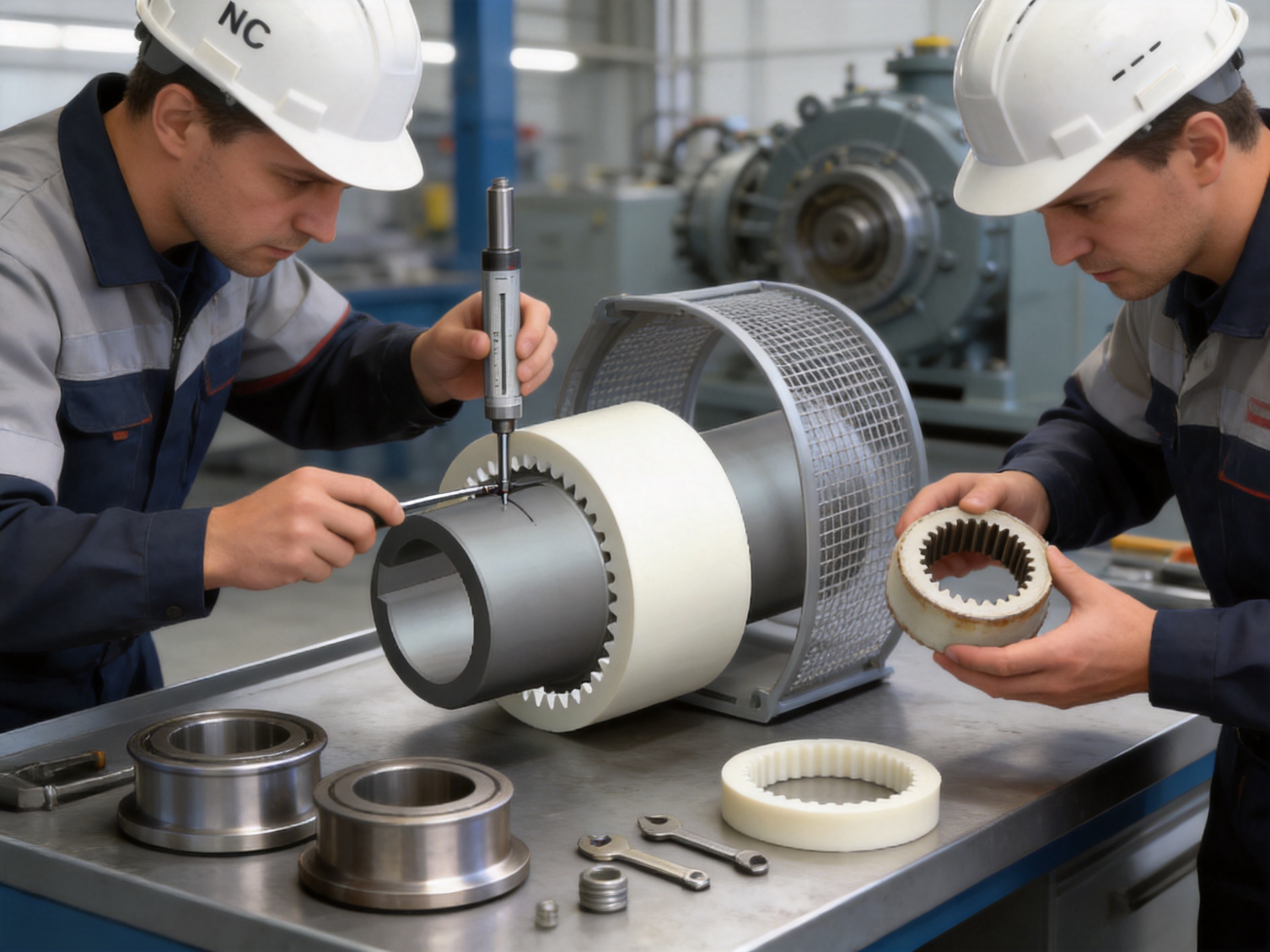
Correct installation is essential for the performance of any flexible coupling. Before assembly, inspect the coupling components for transportation damage, corrosion, contamination, burrs, cracks, or distortion. Confirm that the model, bore size, keyway, shaft spacing, and accessories match the equipment drawing.
The shaft ends should be clean and free from oil, paint, burrs, and foreign material in areas where accurate fitting is required. Check the shaft diameters and key dimensions before mounting the hubs. For keyed connections, the keys should fit correctly without excessive side clearance or interference that could distort the hub.
Mount the hubs according to the approved installation method. Do not hammer directly on the nylon ring, gear teeth, or precision-machined surfaces. If heating is required for an interference fit, the heating method and temperature must be controlled so that the hub material, surface treatment, and adjacent components are not damaged.
Align the driving and driven shafts using suitable measuring equipment. Angular and parallel alignment should be checked in more than one rotational position where practical. Final alignment should be carried out after the machinery has reached its normal installed condition, including the completion of piping, foundation grouting, and connected equipment adjustments.
Confirm the required axial position and ensure that the coupling has adequate space for permitted movement. The coupling should not be forced to absorb large installation errors. Excessive displacement can overload the gear teeth and create abnormal forces even when the coupling is designed for misalignment compensation.
After assembly, rotate the shaft manually where possible to check for interference, binding, unusual resistance, or contact with the guard. Install a suitable coupling guard before operation. The guard must prevent accidental contact with rotating components while allowing appropriate inspection and ventilation.
8. Maintenance and Service-Life Management
The NC coupling is designed to reduce maintenance requirements, but periodic inspection remains good engineering practice. Maintenance intervals should be based on operating hours, load severity, speed, environmental conditions, start-stop frequency, and the consequences of failure.
During inspection, examine the nylon inner gear ring for tooth wear, rounding, cracking, melting, hardening, discoloration, distortion, and chemical attack. Uneven wear may indicate shaft misalignment, excessive torque, vibration, incorrect assembly, insufficient clearance, or a problem in the connected machinery.
Inspect the metallic hubs for tooth pitting, scoring, deformation, corrosion, fretting, cracks, and abnormal contact marks. Check the keyways, retaining components, set screws if used, and shaft fits. Loose or damaged fastening components must be corrected before the equipment is returned to service.
Monitor operating temperature and vibration. A sudden increase in temperature may indicate excessive friction, tooth interference, overload, or misalignment. Increased vibration may result from coupling damage, shaft unbalance, bearing deterioration, foundation looseness, or a process problem. The coupling should be inspected as part of a complete mechanical troubleshooting process.
Keep the coupling protected from abrasive dust, metal scale, water jets, corrosive chemicals, and excessive heat. A properly designed guard can reduce contamination while maintaining safe access for inspection. If the application involves unusual chemicals or temperatures, the compatibility of the nylon material should be confirmed before purchase.
Replacement of the nylon ring should be performed when wear has reached the manufacturer’s specified limit or when damage is visible. Installing a new ring over damaged or severely worn hubs may not provide reliable service. Both hubs should be examined before reassembly, and any component outside the permitted condition should be replaced or repaired.
9. Engineering Considerations for Competitive Selection
Purchasing decisions should be based on total lifecycle value rather than initial purchase price alone. The cost of a coupling includes acquisition, installation, scheduled maintenance, spare parts, lubrication, inspection labor, downtime, and the consequences of premature failure. The NC coupling can offer economic advantages where reduced lubrication and replaceable nylon elements lower recurring maintenance costs.
Another competitive factor is product availability across different torque and bore ranges. The NC1 to NC10 series provides a structured selection from 40 kN·m to 3150 kN·m. A broad standard range simplifies equipment design and helps users maintain consistency across several machines.
Technical support is also important. A coupling supplier should be able to review operating data, confirm model selection, prepare dimensional drawings, recommend materials, and support non-standard requirements. Zhongye Heavy Industry Technology provides custom coupling design and manufacturing, allowing customers to request solutions for special shaft spacing, bore arrangements, load conditions, or equipment interfaces.
Manufacturing capacity is particularly important for heavy machinery projects. A supplier with heavy workshops, precision production areas, testing facilities, warehouse space, and experienced engineering personnel is better positioned to support both standard orders and project-specific products.
Quality consistency can be more valuable than a nominally lower purchase price. Stable tooth dimensions, reliable nylon material, accurate bores, and proper assembly reduce the likelihood of installation problems and premature wear. Buyers should evaluate inspection documentation, production capability, technical responsiveness, and after-sales support alongside the product specification.
10. Ordering and Technical Information Checklist
When requesting a quotation for an NC nylon inner gear ring drum gear coupling, users should provide as much operating information as possible. The following details help the supplier make an accurate recommendation:
1. Motor or driver power and rated speed.
2. Normal operating torque and maximum transient torque.
3. Starting, stopping, braking, reversing, and shock-load conditions.
4. Driving and driven shaft diameters.
5. Required keyway standards and shaft-hole lengths.
6. Shaft spacing and available installation envelope.
7. Expected angular, radial, and axial misalignment.
8. Ambient and operating temperature.
9. Exposure to water, dust, chemicals, oil, metal scale, or abrasive materials.
10. Required rotational speed and speed variation.
11. Applicable industry standards, inspection requirements, and certificates.
12. Quantity, delivery schedule, spare-part requirements, and packaging conditions.
Providing this information allows the supplier to calculate the required service factor and confirm whether the standard NC model is appropriate. If no standard model satisfies the dimensions or operating conditions, the manufacturer can evaluate a customized design.
11. Custom Coupling Design and Manufacturing
Industrial equipment often includes restricted shaft spacing, unusual bore sizes, special flange interfaces, or severe operating conditions that cannot be served by an off-the-shelf coupling. Custom design may be required for original equipment manufacturers, replacement projects, plant upgrades, or machinery imported from different standards systems.
A customized coupling should begin with a technical drawing and operating data review. Engineers need to understand the shaft arrangement, torque path, support bearings, allowable overhung load, axial movement, guard design, and maintenance access. The selected materials and surface treatments should be matched to the environment.
The company’s product portfolio includes toothed couplings, elastic sleeve pin couplings, elastic pin couplings, gear couplings with elastic pins, universal couplings, tire couplings, jaw couplings, star couplings, diaphragm couplings, drum couplings, grid couplings, Oldham couplings, flange couplings, clip-shell couplings, roller-chain couplings, safety couplings, and other non-standard designs.
This broad product knowledge is useful when a project requires more than one coupling type. Engineers can compare alternative technologies and select the design that best matches torque, speed, flexibility, damping, environmental resistance, and safety requirements.
Custom manufacturing may involve modified hubs, special shaft bores, different keyways, altered overall length, special coatings, alternative metallic materials, or customized protective arrangements. Any modification should be reviewed for its effect on balance, tooth loading, rated torque, allowable speed, and assembly procedure.
12. Safety Considerations
Rotating couplings can cause serious injury if they are operated without adequate guarding. The NC coupling must be installed inside a suitable guard that prevents access to rotating components, keys, fasteners, and the nylon ring during operation. The guard should be designed for the maximum operating speed and should not contact the coupling under normal or misaligned conditions.
Before maintenance, isolate and lock out all energy sources. Confirm that the machine cannot start automatically and that stored mechanical, hydraulic, pneumatic, or electrical energy has been released. Never inspect a rotating coupling by hand while the equipment is operating.
When a coupling is used in lifting, braking, reversing, or other high-risk applications, the complete system should include appropriate fail-safe features. A flexible coupling should not be used as a substitute for a brake, torque limiter, overload device, or independent safety mechanism unless the system design specifically permits that function.
Replacement parts should match the specified model and material. Substituting an unapproved nylon ring or modifying the coupling without engineering review may change torque capacity, speed capability, misalignment performance, or chemical resistance.
13. Frequently Asked Questions
Q1: What is an NC nylon inner gear ring drum gear coupling?
An NC nylon inner gear ring drum gear coupling is a flexible mechanical coupling that transmits torque through the engagement between metallic gear hubs and a nylon internal gear ring. Its crowned or drum-shaped tooth design permits controlled angular, radial, and axial movement between connected shafts.
Q2: What standard does this coupling follow?
The product is identified according to Q/YG14021X-2018. The structure is also described as being similar to the TGC-A type drum gear coupling. Project-specific requirements should be confirmed against the applicable drawings and technical documentation.
Q3: Does the nylon ring require lubrication?
The nylon ring is designed to operate with reduced lubrication requirements compared with many all-metal gear couplings. The exact maintenance method depends on speed, load, temperature, environment, and the manufacturer’s instructions. Regular inspection is still recommended even when routine greasing is not required.
Q4: What torque range is available?
The listed NC range covers nominal torque ratings from 40 kN·m for NC1 to 3150 kN·m for NC10. The appropriate model must be selected using actual operating torque, service factors, speed, shaft diameter, and load characteristics.
Q5: What is the maximum allowable speed?
Allowable speed varies by model. NC1 through NC4 are listed at up to 6000 r/min, NC5 and NC6 at up to 5000 r/min, NC7 and NC8 at up to 3600 r/min, NC9 at up to 2000 r/min, and NC10 at up to 1800 r/min.
Q6: Can the coupling compensate for shaft misalignment?
Yes. The drum-shaped tooth profile is designed to accommodate a specified amount of angular, radial, and axial misalignment. The permitted values vary by model and must not be exceeded. Proper initial alignment is still necessary to prevent premature wear.
Q7: Is the coupling suitable for high-temperature service?
Suitability depends on the actual operating temperature and the grade and condition of the nylon material. Nylon properties can change with temperature, moisture, and chemical exposure. High-temperature applications should be reviewed with the manufacturer before selection.
Q8: Can the nylon gear ring be replaced separately?
The modular construction is intended to support inspection and replacement of the nylon inner gear ring. The hubs should be inspected at the same time. If the metallic gear teeth or shaft connections are damaged, replacing only the ring may not be sufficient.
Q9: What industries use this coupling?
Typical application areas include metallurgy, mining, water equipment, lifting machinery, paper-making equipment, port machinery, conveyors, pumps, gearboxes, and other industrial power transmission systems.
Q10: Can the manufacturer provide customized couplings?
Yes. The company undertakes the design and manufacture of non-standard couplings. Customers should provide shaft dimensions, torque, speed, alignment conditions, installation limits, environmental information, and applicable standards for technical evaluation.
Q11: How should the coupling be protected?
The coupling should be installed with a suitable guard that prevents contact with rotating components and protects the assembly from contamination. The guard must provide adequate clearance and should be designed for the coupling’s maximum operating speed.
Q12: What information is needed for model selection?
Important information includes power, speed, operating and peak torque, shaft diameters, keyways, shaft spacing, misalignment, temperature, contaminants, start-stop frequency, braking conditions, and required documentation. This information allows the supplier to select a suitable model and service factor.
14. Why Choose This Coupling for Industrial Equipment?
The NC nylon inner gear ring drum gear coupling offers a balanced combination of high torque transmission, flexible alignment capability, reduced lubrication requirements, compact construction, and maintainable components. These advantages make it a strong candidate for industrial users who want to improve equipment availability without adopting a highly complex coupling system.
Compared with conventional all-metal gear couplings, the nylon gear ring can simplify lubrication practices and reduce metal-to-metal contact. Compared with smaller elastomeric couplings, the NC series provides a substantially broader heavy-torque range. Compared with certain flexible-element couplings, its gear engagement provides a practical solution where shaft diameter and torque capacity are major design constraints.
The product is supported by a manufacturer with experience across multiple coupling technologies, dedicated heavy and precision workshops, testing capabilities, customization support, and an industrial customer base. The company’s ability to provide standard products and non-standard engineering solutions gives equipment manufacturers and maintenance departments additional flexibility when developing or upgrading power transmission systems.
For the best result, users should treat coupling selection as part of the complete machine design. Torque, speed, alignment, environment, installation, guarding, and maintenance must be considered together. When these factors are correctly evaluated, the NC coupling can provide dependable performance, simplified service, and long-term value in demanding industrial applications.
15. Conclusion
The NC nylon inner gear ring drum gear coupling is a practical flexible coupling for industrial machinery requiring reliable torque transmission and controlled shaft movement. Its hybrid structure combines metallic hubs with a nylon inner gear ring, creating a solution that offers high load capability while reducing some of the maintenance demands associated with conventional all-metal gear couplings.
The crowned gear tooth design supports angular, radial, and axial misalignment compensation within specified limits. The nylon element can reduce friction, operating noise, and lubrication requirements, while the modular structure allows inspection and replacement of the ring when necessary. With models ranging from NC1 to NC10, the series covers a wide range of torque, speed, and shaft-bore requirements.
Manufacturing capability is a key part of the product’s value. Research and development, heavy fabrication, precision machining, testing, quality control, standard production, and customized design support enable the supplier to serve both standard equipment and specialized industrial projects.
For metallurgy, mining, water equipment, lifting machinery, paper-making systems, port equipment, conveyors, pumps, and other rotating machinery, the NC coupling provides a strong balance between performance and maintainability. Proper engineering selection, accurate alignment, suitable guarding, and scheduled inspection will help users achieve the longest and most reliable service life.
References
1. Q/YG14021X-2018, Technical requirements and dimensional data for the NC nylon inner gear ring drum gear coupling.
2. Manufacturer-supplied technical table for NC1 through NC10 coupling models.
3. General principles of flexible shaft coupling selection, including torque, speed, misalignment, service factor, and installation requirements.
4. ISO 9001, Quality management systems—Requirements.
5. General industrial power transmission engineering practices for gear couplings, shaft alignment, guarding, inspection, and maintenance.
Product: NC Nylon inner gear ring drum gear coupling(Q/YG14021X-2018)

- Quick Links
- About
- Products
- Our Service
- News & Events
- Contact
- Products Series
- Flexible Couplings with Non-Elastic Elements
- Flexible Couplings with Metal Elastic Elements
- Flexible Couplings with Non-Metallic Elastic Elements
- Safety Coupling
- Rigid Coupling
- Contact Us
- Tel : +86 511 8572 3800 +86 511 8572 3900
- Mobile : +86 15106109009
- Email : sales@couplingzy.com
- Add:No.1 Zhongye Yingbin Avenue, Gaozi Street, Dantu Economic Development Zone, Zhenjiang City, Jiangsu Province, China.


